 English EN


What Food Products Are Made With Edible Gelatin
Edible gelatin is found in gummy candies, marshmallows, yogurt, fruit snacks, jello, trifles, and many processed foods. Check labels for gelatin sources.
More
Edible gelatin granules are one of the most practical forms of gelatin for food manufacturers and formulators. This guide walks through the key physical and functional properties of granular gelatin, how they differ from sheets and powders, what to check when sourcing, and how to store the material so it performs consistently from batch to batch. Whether you are scaling a gummy line or refining a dessert formula, understanding these basics helps you make a more informed purchasing decision.
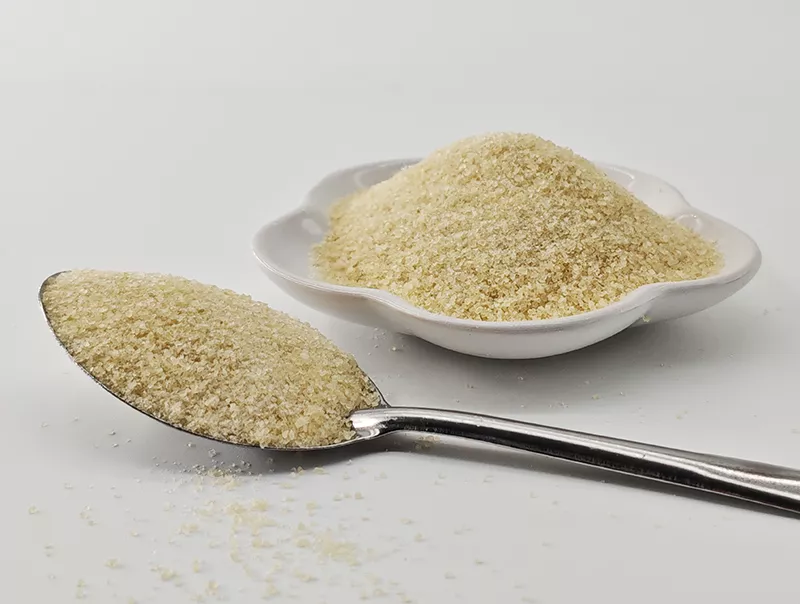
Gelatin granules sit in a useful middle ground. They flow more freely than fine powder, which reduces dust on the production floor, and they dissolve more predictably than some sheet formats when you need to meter ingredients by weight. For many food applications, that combination of handling ease and consistent behavior is exactly what a production team wants.
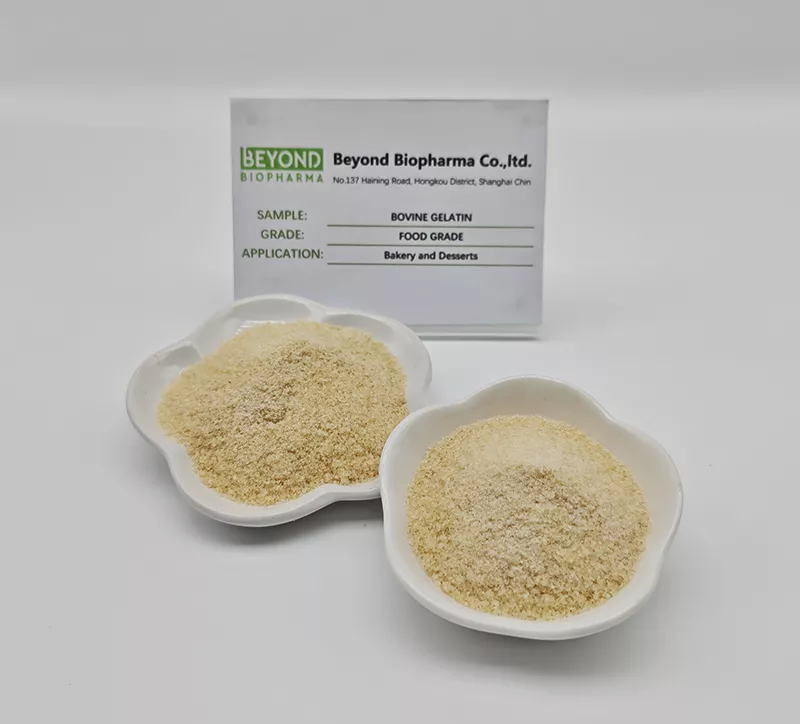
The source material matters more than the physical form, but form still affects how you work with gelatin day to day. Granules are produced by drying and milling gelatin into small, roughly uniform particles. Compared with a fine powder, granules have less surface dust and better flow, which makes them easier to dose accurately on automated equipment. Compared with sheets, they skip the soaking step and can be added directly to water for blooming.
The core properties remain the same regardless of form. Bloom strength, viscosity, and clarity are determined by the collagen source and the extraction process, not by whether the gelatin is sold as a sheet, powder, or granule. A 200 Bloom granule and a 200 Bloom sheet will set a gel of similar firmness when used at the same concentration.
Bloom strength. This is the single most quoted number in gelatin purchasing, and for good reason. It measures gel firmness, and most food-grade gelatin falls between 80 and 300 Bloom. Bovine and pork gelatin commonly sit in the 200–300 range, while fish gelatin tends to land somewhat lower, around 200–250. If your formula depends on a firm, heat-stable set, a higher Bloom granule gives you more room to adjust concentration.
Melting point. Bovine and pork gelatin typically melt between 30°C and 35°C, which holds shape at room temperature but melts smoothly in the mouth. Fish gelatin melts lower, roughly 15°C to 25°C, making it better suited to chilled desserts and applications where quick melting is a feature rather than a problem.
Clarity and color. For layered desserts, fruit domes, or any product where appearance sells, granule clarity matters. A well-processed granule yields a clean, transparent gel. Ask for a sample and set a test gel before committing to a large order.
Odor and flavor. Bovine and pork gelatin are generally neutral. Fish gelatin can carry a mild note, though modern deodorization removes most of it. If your product has a delicate flavor profile, request an odorless grade.
For a closer look at how bovine gelatin performs in food formulations, the edible bovine gelatin product page covers specifications and application notes in more detail.
Sourcing gelatin is less about finding a supplier and more about verifying that the material matches your regulatory and formulation needs. A few checks cover most of the ground:
Suppliers with sustained capacity and stable quality are worth prioritizing. A producer running 5,000 tons per year with two decades of experience is more likely to deliver consistent granules across repeat orders than a smaller operation still dialing in its process. You can download the Technical Data Sheet for Edible Bovine Gelatin to see the kind of specification detail a serious supplier provides.
Many kitchens and plants use both formats for different jobs. Sheets are convenient for small-batch pastry work because you can count them and soak them in ice water. Granules suit larger batches and automated dosing, where weighing is more practical than counting. If your operation relies on standardized sheets for consistency, the standardized gelatin sheets range is worth reviewing alongside granule options. The sheet technical data sheet gives a useful side-by-side reference for Bloom grades.
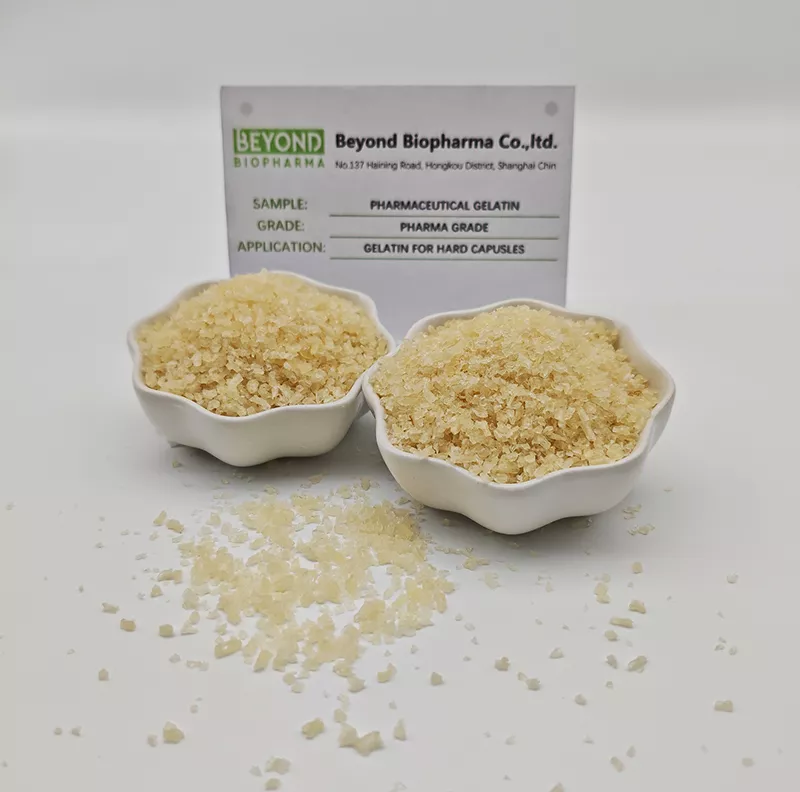
For micro-encapsulation work, granule size and dissolution behavior become more critical because the gelatin acts as a barrier around core materials. The gelatin for micro-encapsulation page explains how the material is specified for that application.
Granules absorb moisture readily, so storage discipline directly affects shelf life. Keep the material in a cool, dry place away from direct sunlight, and seal containers tightly after each use. High humidity causes clumping, and gelatin can pick up odors from its surroundings, so store it away from strong-smelling ingredients. Under proper conditions, most food-grade gelatin holds quality for 24 to 36 months. If the granules change color, develop an off smell, or form hard lumps, discard them.
When blooming, sprinkle granules evenly over cold water at roughly a 1:5 gelatin-to-water ratio and let them sit for five to ten minutes until spongy. Then apply gentle heat to dissolve — avoid boiling, which degrades gel strength. This routine works the same whether you are making a test gel in the lab or a full production batch.
Soft desserts like panna cotta and mousse benefit from a lower-melting gelatin that gives a delicate set. Chewy candies and gummies want higher Bloom strength for a firm, resilient bite. Savory applications such as aspics and terrines rely on the heat stability of bovine or pork gelatin at the 30–35°C melting range. If your market includes Halal, Kosher, or pescatarian consumers, fish gelatin granules are the practical choice, and the Halal Kosher fish gelatin data sheet covers the certification details.
The honest answer to "which granule should I buy" is that it depends on your formula, your equipment, and your certification requirements. Start with a clear specification, request samples, and test before you commit to volume. That approach saves far more time than chasing the lowest price per kilogram.

We provide you with comprehensive foreign trade solutions to help enterprises achieve global development
20 years experiences, 5000 ton/year capacity, Sustained supply with stable quality
The High-Performance Barrier for Core Material Protection and Controlled Release.
Precision, Purity, and Optimal Machinability
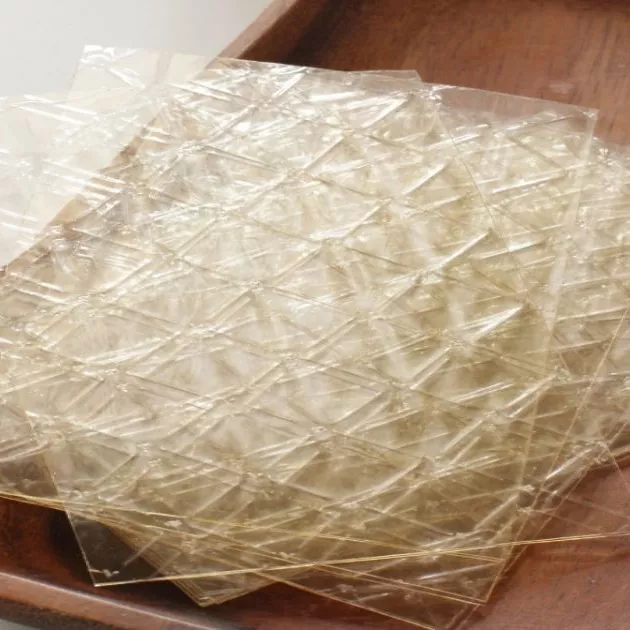
Our Gelatin Sheets are produced to precise standards, ensuring consistency and reliability across different Bloom grades (Silver being the most common professional choice).
Select the most popular foreign trade service products to meet your diverse needs
Source wholesale hydrolyzed walnut protein peptide powder in bulk. Over 85% low-molecular-weight oligopeptides rich in Glutamic Acid. Perfect for cognitive formulas and sleep aid supplements.
High Molecular Weight for Superior Joint, Skin, and Eye Health.
Source ultra-pure, 100% water-soluble wholesale hydrolyzed rice protein peptide in bulk. Over 85% molecules under 1000 Da. Ideal for infant nutrition, clean-label sports formulas, and sensitive skincare.
Tel:+86 21 65010906
Cell/Whatsapp/Wechat:
+86 13482884055
+86 18657345785
Email: sales@beyondbiopharma.com





User Comments
Service Experience Sharing from Real Customers
Mike
Pastry ChefBeen using these gelatin granules for about six months now in my bakery and honestly they dissolve way faster than the sheets I used before. No clumping, no weird smell. My panna cotta sets perfectly every single time. Only thing I'd say is the bag could reseal better, but that's minor.
Sarah
Home Baking BloggerI bought this on a whim for making homemade marshmallows and gummy bears with my kids. It worked great! The granules bloom nicely in cold water and dissolve clear. Took off one star because the package arrived a bit dented, but the product itself was sealed fine. Would order again.
David
Production ManagerWe switched our capsule production line to this edible gelatin about a year ago and the consistency has been rock solid. Batch-to-batch variation is minimal which is critical for us. Gel strength is right where it should be. Our QC team has zero complaints so far.
Jenny
Culinary Arts StudentMy instructor recommended granulated gelatin over sheets for beginners and I totally get why now. It's forgiving, easy to measure, and I don't have to deal with soaking sheets and squeezing them out. Used it for a mirror glaze last week and it came out super smooth. Good stuff for the price.