You face a fast-growing market as a collagen manufacturer.
The collagen market may rise from $7.5 billion in 2025 to $8.24 billion in 2026, with a CAGR of 9.9%.
Demand grows with dietary supplements and pharmaceuticals. By using innovation and sustainable practices, you can match consumer values and strengthen your brand.
Key Takeaways
The collagen market is set to grow significantly, reaching $8.24 billion in 2026. Manufacturers should innovate and adapt to meet rising consumer demand for health and wellness products.
Sustainable sourcing and transparency in ingredient sourcing are crucial. Brands that prioritize eco-friendly practices and clean labels gain a competitive edge.
Embrace technology and digital transformation. Using advanced tools can improve efficiency, enhance product quality, and help manufacturers connect with consumers effectively.
You see strong growth in the collagen market. The market size reached $7.5 billion in 2025 and is projected to grow to $8.24 billion by 2026. The compound annual growth rate stands at 9.9%. You benefit from rising dietary supplement consumption, greater awareness of protein nutrition, and expanding pharmaceutical uses.
More people want health and wellness products.
Innovations in product formats, such as gummies and beverages, attract new customers.
Beauty-from-within and healthy aging trends boost collagen adoption.
Asia-Pacific shows rapid growth, with a CAGR of 9.15% from 2026 to 2031. Europe remains the largest region in the collagen market. You can target these regions for expansion.
Consumer Trends Impacting Collagen Manufacturers
You notice that consumers focus on wellness benefits and functional indulgence. They want beauty-from-within and healthy aging solutions. Many prefer convenient, on-the-go nutrition. Collagen has moved from a niche ingredient to a mainstream value-driver.
You align your products with clean label trends and active lifestyle nutrition. Consumers demand transparency in ingredient sourcing. You respond by offering non-GMO and organic-certified options. Brands that highlight purity and sustainability gain a competitive edge.
Expanding Applications for Collagen Manufacturers
You expand into new applications. Collagen is used in healthy food products, beverages, and probiotic drinks. Manufacturers create collagen-infused drinks, such as soy, cocoa, and energy drinks. Hydrolyzed collagen offers antioxidant and antimicrobial properties. It enhances calcium bioavailability and helps maintain food quality. You also target cosmetics and biomedical sectors. Collagen supports skin elasticity, hydration, and anti-aging. Premium skincare brands use marine and bioactive collagen for better absorption and purity.
Essential Collagen Manufacturer Strategies
Product Innovation and High-Purity Formulations
You drive success by focusing on product innovation. You use new technologies to improve raw material processing and traceability. You partner with technology providers to boost extraction efficiency and product efficacy. You tailor products for specific needs, such as joint care or skin rejuvenation. You reach younger consumers through digital marketing and e-commerce.
Strategy Type
Description
Technological Advancements
Innovations in raw material processing and traceability technologies ensure consistent supply and quality.
Collaboration with Technology
Partnering with technology providers enhances extraction efficiency and product efficacy, securing a competitive edge.
Consumer-Centric Product Development
Tailoring products to meet specific consumer needs, such as joint care or skin rejuvenation, drives demand.
Digital Marketing Strategies
Utilizing e-commerce and social media to reach younger consumers and enhance brand visibility.
Differentiation through Innovation
Combining collagen with bioactive compounds and developing multi-functional formulations to stand out in the market.
Vertical Integration
Emphasizing control over processing steps to improve quality and traceability while managing risks.
R&D Investments
Continuous investment in research and development to enhance product offerings and maintain market relevance.
High-purity formulations give you a strong advantage. You offer extensive customization options for collagen products. You work with formulation experts to create unique blends. You add beneficial ingredients to boost product value. High-purity collagen ensures consistent quality and better bioavailability. You help brands create innovative products for functional foods and nutraceuticals. You build consumer trust and increase market appeal.
High-end nutraceutical brands use collagen peptides with over 90% low-molecular-weight content. They report improved bioavailability.
Customization features let brands target specific market segments and enhance their value.
Tip: You can stand out by combining collagen with bioactive compounds and developing multi-functional products.
Sustainable Sourcing and Supply Chain Optimization
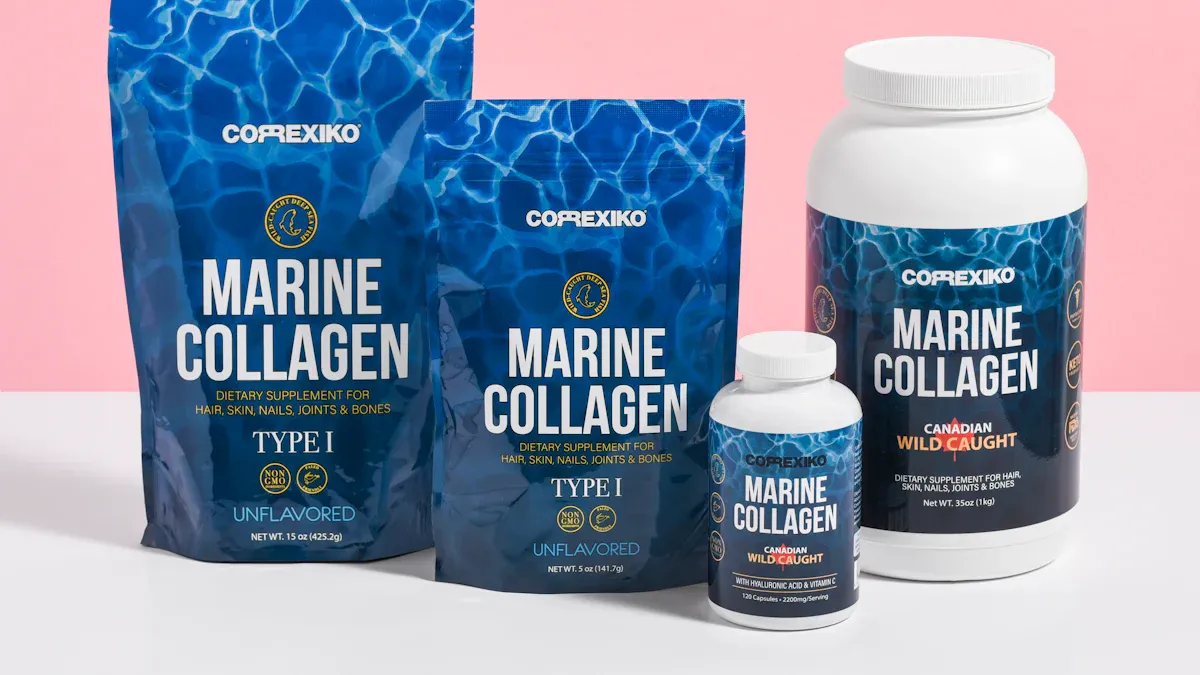
You adopt sustainable sourcing practices to protect the environment and meet consumer expectations. You source marine collagen from fish by-products, such as skin and scales, that would otherwise be wasted. You choose suppliers certified by organizations like the Marine Stewardship Council. You explore lab-grown marine collagen as a sustainable alternative.
Marine species offer lower disease transmission risks and high biocompatibility.
Fish skins and bones provide promising sources with high collagen content.
You compare extraction methods to find the most efficient and sustainable practices.
Supply chain optimization helps you save costs and improve efficiency. You enhance sourcing strategies to reduce expenses. You use traceability systems to ensure supplier reliability and compliance. You adopt new extraction technologies to tailor products for market demands.
Note: Optimizing your supply chain builds trust with consumers and regulators. It also helps you manage risks and maintain quality.
Regulatory Compliance for Collagen Manufacturers
You face strict regulatory requirements in major markets. In China, the National Medical Products Administration reviews safety and efficacy for recombinant collagen-based medical devices. You must conduct clinical follow-ups after marketing new biomaterials. You document and address any adverse events.
You ensure compliance with food safety and labeling standards by following frameworks like ISO 22000. You use good manufacturing practices and maintain transparency in sourcing and labeling. This approach helps you manage complex supply chains and builds trust with consumers and regulators.
Alert: Staying updated on regulatory changes is essential for your long-term success.
Regional Market Targeting and Expansion
You expand into new geographic markets by focusing on product innovation and forming strategic alliances with healthcare institutions. You navigate regulatory approvals to strengthen your market position. You differentiate your products based on efficacy and safety. You build strong distribution channels and comply with local regulations.
Smaller regional players can meet local needs by offering cost-effective solutions. Mergers and acquisitions help you diversify offerings and expand geographically. Strategic marketing and educational initiatives increase product adoption among healthcare professionals.
Tip: You can boost adoption in new regions by educating healthcare professionals and highlighting your product’s benefits.
You face several challenges that can increase your production costs. Raw material prices often change, and supply chain disruptions can cause delays. Consumers want fresh products and believe that collagen may not match the nutrition of whole foods. The table below shows common cost challenges:
Challenge
Description
Fluctuating Raw Material Prices
Prices change often, making it hard to control costs.
Supply Chain Issues
Delays and disruptions raise expenses.
Consumer Preference for Fresh
People want fresh products, not just processed ones.
Perceived Nutritional Value
Some believe collagen lacks nutrition compared to whole foods.
You can improve efficiency by using automation and AI. These tools help you reduce waste by 45% and boost energy savings by 40%. Automation also lowers costs and improves product quality.
Addressing Regulatory and Quality Barriers
You must follow strict safety and quality rules. You need to meet standards for medical devices and food products. You also have to control the quality of animal-based materials. The table below highlights key barriers:
Challenge Type
Description
Compliance with Safety Standards
You must prove your products are safe and effective.
Quality of Raw Materials
You need to follow rules for animal-based ingredients.
Complex Regulations
You must understand many guidelines for different markets.
Sustainability Concerns
You should show that your sourcing and processing are eco-friendly.
Consistency in Product Quality
You must test your products to keep quality high and build trust.
You can use advanced testing methods like HPLC and mass spectrometry to check purity and safety.
Ensuring Reliable Raw Material Supply
You need a steady supply of raw materials to keep production running. Risks include new rules for animal products, market changes, and global events that slow shipping. You can build a strong supply chain by using batch-level records, transparent sourcing, and following HACCP and ISO standards. Keeping steady inventory and flexible schedules helps you avoid shortages. Certifications like Halal and Kosher let you reach more customers.
Tip: A resilient supply chain protects your business from unexpected problems.
Differentiation Opportunities for Collagen Manufacturers
Clean Label and Transparency Initiatives
You can set your products apart by focusing on clean label strategies. Consumers want to know where their ingredients come from and how they are processed. You can use sustainable sourcing, allergen-free formulations, and transparent ingredient labeling. The table below shows common clean label initiatives:
Initiative Type
Description
Sustainable Sourcing
Marine collagen sourced from certified fisheries and poultry-based collagen from traceable supply chains.
Allergen-Free Formulations
Development of products that cater to consumers with specific dietary restrictions.
Transparent Ingredient Sourcing
Clear labeling and sourcing information to meet consumer demand for ethical consumption.
Minimal Processing
Focus on reducing processing to maintain product integrity and appeal to health-conscious consumers.
Sustainability Certifications
Investment in certifications that validate sustainable practices, allowing for premium pricing.
You build trust by sharing sourcing details and following strict quality controls. You also support eco-friendly packaging and responsible sourcing.
Personalized Nutrition and Custom Solutions
You can meet consumer needs by offering personalized nutrition. Many people follow diets like low calorie, intermittent fasting, gluten-free, or keto. You can create products that support hydration, healthy aging, digestive health, immune system health, and women’s health. You offer custom formulas, adapt ready-made blends, and provide flexible packaging. The table below highlights customization options:
Customization Options
Description
Fully-Custom Formulas
Manufacturers can create entirely new products tailored to specific consumer needs.
Adaptations of Ready-Made Blends
Existing products can be modified to better suit target audiences.
Quality Assurance Processes
Ensures that the final product meets health benefit claims and safety standards.
Flexible Packaging Solutions
Products can be packaged in various formats to appeal to different market segments.
You can develop custom flavors and add functional ingredients to enhance your products.
Leveraging Technology and Digital Transformation
You gain a competitive edge by using advanced technology. You can use forecasting tools and supply chain visibility systems to improve efficiency. E-commerce platforms help you connect with customers and streamline operations. IoT-enabled equipment lets you monitor production in real time. Automation systems reduce downtime and costs. You can use extraction and processing technology to produce high-purity collagen. Enzymatic hydrolysis creates peptides for specific health benefits. Nanotechnology improves delivery and absorption. Digital tools like AI and machine learning help you develop products and understand consumer needs. Bioreactor systems scale up production while maintaining quality. Plant-based alternatives expand your market reach. Personalized solutions use data analytics for targeted formulations.
Smart technologies help you adapt to market changes and maintain operational excellence as a collagen manufacturer.
You succeed as a collagen manufacturer when you focus on innovation, sustainability, and adaptability. Use new technology, improve your supply chain, and meet changing consumer needs. Stay alert to market trends. Embrace change and look for new opportunities. These strategies help you lead the market in 2026.
FAQ
What makes high-purity collagen important for your products?
High-purity collagen gives you better absorption and consistent quality. You can trust the results and meet customer expectations for safety and effectiveness.
How can you ensure your collagen is sustainably sourced?
You should choose suppliers with sustainability certifications. You can also use marine by-products and support eco-friendly practices to protect the environment.
Why does regulatory compliance matter for you as a collagen manufacturer?
Regulatory compliance helps you avoid legal issues. You build trust with customers and open doors to more markets by following safety and labeling rules.
Bridging the gap between molecular science and functional food, I specialize in the structural versatility of gelatin and collagen peptides. Leveraging advanced laboratory insights, I provide deep dives into Bloom strength optimization, solubility profiles, and clean-label manufacturing. My mission is to empower formulators with the technical clarity needed to develop the next generation of pharmaceutical and nutraceutical products.
Related Products
We provide you with comprehensive foreign trade solutions to help
enterprises achieve global development
Source ultra-pure, 100% water-soluble wholesale hydrolyzed rice protein peptide in bulk. Over 85% molecules under 1000 Da. Ideal for infant nutrition, clean-label sports formulas, and sensitive skincare.
Our Gelatin Sheets are produced to precise standards, ensuring consistency and reliability across different Bloom grades (Silver being the most common professional choice).
Undenatured Collagen Type II for Joint Comfort and Mobility
BEYOND BIOPHARMA is a specialized manufacturer of high-quality Undenatured Collagen Type II. Utilizing low-temperature, non-enzymatic extraction methods, our Undenatured Collagen Type II retains its native, triple-helix structure, essential for modulating the immune system's response to joint health and providing superior support for mobility, flexibility, and overall joint comfort.
Collagen Peptide
Hot-Sale Products
Select the most popular foreign trade service products to meet your
diverse needs
Learn more about the dynamics and professional knowledge of the foreign
trade industry
2026-09-14 16:48:07Read 905
Which halal, kosher and non-GMO certifications actually close collagen peptide deals
IFANCA, OU, and Non-GMO Project Verified are the halal, kosher, and non-GMO certifications that actually close collagen peptide deals. Buyers recognize these marks immediately.
How collagen peptide degree of hydrolysis and molecular weight distribution are tested
Collagen peptide degree of hydrolysis is tested via TNBS or OPA assays. Molecular weight distribution via SEC. These tests verify quality and bioavailability.
Gelatin Supplier Audit: 20 Questions to Ask Before Your First Purchase Order
Conduct a gelatin supplier audit with this 20-question checklist to verify regulatory compliance, raw material purity, Bloom strength, and batch consistency.
Been sourcing collagen for our new serum line and their marine collagen peptides are a game-changer. The particle size is consistently perfect for absorption, and their tech team actually answered my super niche question about hydrolysis levels within a day. Not just a supplier, feels like a partner.
Leo
Fitness Supplement Shop Owner
5.0
Ordered the bovine collagen in bulk for my store. The unflavored version mixes without that weird clumping issue others have. My customers notice the difference in recovery time. Took off one star because the bulk packaging could be a bit sturdier for shipping, but the product itself is top-notch.
Sam
R&D Scientist
5.0
As someone who's tested collagen from maybe a dozen manufacturers, their documentation and Certificates of Analysis are impressively thorough. We needed specific amino acid profile data for a clinical trial, and they had it all ready. This level of transparency is rare and saves us weeks of validation work.
Chloe
Founder of a Small Wellness Brand
5.0
Honestly, I was nervous switching from a big-name supplier to them. But their sales rep, Jake, walked me through everything—no pressure. The sample batch for my vegan collagen boosters was perfect, and the minimum order quantity is actually manageable for a startup like mine. Couldn't be happier.
Search Keywords
Explore more content related to foreign trade services

 English EN













User Comments
Service Experience Sharing from Real Customers
Megan
Skincare FormulatorBeen sourcing collagen for our new serum line and their marine collagen peptides are a game-changer. The particle size is consistently perfect for absorption, and their tech team actually answered my super niche question about hydrolysis levels within a day. Not just a supplier, feels like a partner.
Leo
Fitness Supplement Shop OwnerOrdered the bovine collagen in bulk for my store. The unflavored version mixes without that weird clumping issue others have. My customers notice the difference in recovery time. Took off one star because the bulk packaging could be a bit sturdier for shipping, but the product itself is top-notch.
Sam
R&D ScientistAs someone who's tested collagen from maybe a dozen manufacturers, their documentation and Certificates of Analysis are impressively thorough. We needed specific amino acid profile data for a clinical trial, and they had it all ready. This level of transparency is rare and saves us weeks of validation work.
Chloe
Founder of a Small Wellness BrandHonestly, I was nervous switching from a big-name supplier to them. But their sales rep, Jake, walked me through everything—no pressure. The sample batch for my vegan collagen boosters was perfect, and the minimum order quantity is actually manageable for a startup like mine. Couldn't be happier.