
EN
Product developers select a manufacturing partnership based on budget, launch timeline, and technical specifications. Analyzing private label vs oem vs odm options helps teams align commercial strategy with production goals. Choosing oem or odm balances bespoke specifications with baseline efficiency. A streamlined turn-key path allows an emerging brand to launch a product fast. Meanwhile, custom hydrolysis delivers total IP control and tailored molecular weight profiles.
Model | Key Advantage | IP Control |
|---|---|---|
Standard Option | Rapid market entry | Low |
Custom Hydrolysis | Targeted bioactivity | Maximum |
Selecting the ideal plant peptide oem odm model protects brand differentiation. Ultimately, evaluating private label vs oem choices optimizes capital investment.
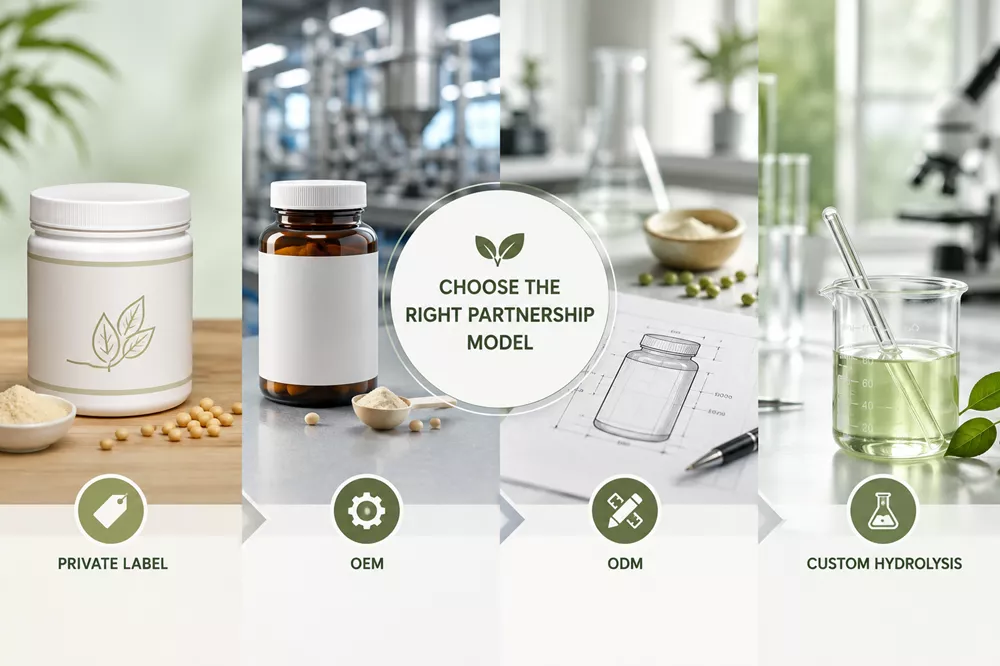
Understanding private label vs oem vs odm options helps a brand select the right production strategy. A private label manufacturer supplies pre-formulated plant peptides under a client label. This private label option features low startup costs of $5k-$20k and short lead times of 4-8 weeks. An original equipment manufacturer creates a customized product based on brand specifications. An OEM partner requires higher startup costs of $20k-$100k and lead times of 12-24 weeks. An original design manufacturer supplies complete turnkey formulations alongside regulatory support and sales support. Beyond Biopharma operates as a premier plant peptide oem odm supplier, supporting standard supply and custom blending.
Dimension | Private Label | OEM | ODM |
|---|---|---|---|
Formula Control | Existing formula | Custom brand specification | Turnkey ODM design |
Lead Time | 4-8 weeks | 12-24 weeks | Fast execution |
Startup Cost | $5k-$20k | $20k-$100k | Moderate cost |
Comparing private label vs oem operational trade-offs clarifies long-term positioning. The choice between private label vs oem depends on formula control. Private label lowers financial risk for new entrepreneurs testing a private label product. An original equipment manufacturer provides proprietary exclusivity for a scaling enterprise. An original design manufacturer offers ready-made ODM solutions for quick market entry. Examining private label vs oem defined parameters helps teams select a suitable private label strategy or OEM project.
Custom hydrolysis represents the highest engineering tier for custom formulation manufacturers. Brand managers work directly with an oem partner to dictate bioactivity targets in a plant peptide oem odm framework. Beyond Biopharma utilizes targeted exopeptidases and controlled enzymatic cleavage during hydrolysis. This advanced oem process breaks plant proteins into low-molecular-weight peptides from 1,000 to 3,000 Da. These custom peptides deliver rapid digestion, high bioavailability, and top quality performance.
Custom formulation manufacturers leverage custom hydrolysis to eliminate sensory challenges in plant proteins. Beyond Biopharma applies specialized debittering methods to produce a custom plant protein peptide line. This portfolio features pea, soybean, rice, wheat gluten, corn, and walnut sources. These custom plant peptides achieve 100% cold-water clarity without grit. An ODM or OEM contract manufacturing model offers complete customization and manufacturing flexibility for any growing brand.
Brand managers must evaluate capital expenditure and order volume constraints when entering the market. Analyzing private label vs oem vs odm parameters clarifies financial commitments for corporate buyers. A private label manufacturer delivers low financial risk for emerging enterprises. Furthermore, a private label model allows small companies to test new plant protein peptide concepts without heavy capital burdens.
An original design manufacturer provides ready-made formulas with moderate financial investment. An original equipment manufacturer demands higher capital because custom engineering requires dedicated R&D resources. Brand procurement teams must align production volumes with company growth targets.
Manufacturing model | Typical MOQ | Upfront capital |
|---|---|---|
Private label | 100–500 units | Lowest |
ODM | 1,000–5,000 units | Medium |
Custom OEM | 5,000–10,000+ units | Highest |
Selecting a business model requires strategies for choosing between private label and oem paths based on resource allocation. Private label supply limits early capital exposure while offering fast market access. However, custom OEM formulations protect long-term profit margins for expanding firms. OEM contracts provide maximum scalability and growth support as order volumes scale. Working with custom formulation manufacturers enables enterprises to secure operational flexibility across variable batch sizes. Meanwhile, an ODM partner supplies formula modification options to bridge standard manufacturing and bespoke production.
Intellectual property rights determine long-term brand differentiation in competitive nutrition markets. A contract manufacturing deal establishes distinct parameters for formula ownership and processing parameters. Private label arrangements grant zero intellectual property rights to the client. The supplier retains full control over the underlying recipe and peptide processing technology. This setup restricts unique formulations because competitors can purchase identical off-the-shelf items.
The private label vs oem dynamic changes dramatically regarding formula exclusivity. OEM contracts transfer complete ownership of proprietary hydrolysis parameters to the buying organization. Brands working with custom formulation manufacturers secure complete ownership of specific peptide molecular weight profiles. Custom hydrolysis parameter ownership prevents rival companies from copying sensory characteristics or bioactivity performance.
An ODM partnership approach offers a balanced solution for growing enterprises. The original design manufacturer usually retains core platform patents but grants exclusive regional product rights to the buying company. Brand managers must review contract terms carefully to verify legal protection before funding commercial development.
Clear intellectual property definitions protect brand equity and secure technical advantages during commercial scaling.
Choosing the ideal plant peptide oem odm model requires balancing formula control against initial investment. Private label options offer maximum operational flexibility for immediate product testing and standard branding needs. ODM projects deliver medium operational flexibility with baseline market protection. Advanced OEM processing delivers total control over ingredient specifications, batch quality, and bioactive profiles. Companies secure long-term product distinction by matching business models to organizational capabilities.
A growing business must align its manufacturing deal with operational maturity. Startup enterprises often select a standard private label framework to launch items quickly. Small businesses order initial runs as low as 150–500 units for capsules, powders, or liquid formats. This turnkey strategy offers fast market entry within 4–8 weeks from concept to commercial launch. Early ventures test basic consumer demand without taking big financial risks. Founders deploy existing shelf-stable recipes to conserve capital and minimize inventory strain.
Expanding companies need modified off-the-shelf options to achieve brand differentiation. These mid-stage companies adopt an odm model. An odm strategy delivers custom modifications while maintaining steady sales support from experienced food scientists. Buyers secure formula flexibility alongside intermediate order quantities around 1,000 to 5,000 units per SKU. This partnership approach helps growing teams release unique formulations without long laboratory delays. An oem contract grants exact control over product design as order volumes rise. Furthermore, intermediate brands adjust flavoring systems and active ingredient ratios to capture distinct consumer segments.
Enterprise organizations require total control over ingredient specifications. These large corporations utilize a custom oem framework. Enterprise buyers demand custom hydrolysis to engineer target peptide chains for specialized nutritional functions. An oem arrangement provides scalability and growth support for mass distribution across international retail channels. Dedicated production lines deliver maximum operational flexibility and long-term supply stability. Large brands protect their market positioning by securing proprietary processing parameters across high-volume production cycles.
Brand Maturity | Manufacturing Model | Minimum Order Quantity | Lead Time |
|---|---|---|---|
Startup | Private label | 150–500 units | 4–8 weeks |
Growth Brand | ODM | 1,000+ units | 6–12 weeks |
Enterprise Brand | Custom OEM | 2,500–5,000+ units | 12–18 weeks |
Beyond Biopharma produces a plant protein peptide portfolio for diverse commercial sectors. The versatile product lineup features hydrolyzed pea, soybean, rice, wheat gluten, corn, and walnut protein peptides. These ingredients achieve 100% cold-water clarity without clumping, sediment, or grit across wide pH ranges. Multi-stage purification processes generate a neutral, debittered taste profile that reduces heavy masking agents. These functional advantages allow easy incorporation into clear functional beverages, protein waters, sports nutrition recovery shakes, and plant-based nutrition bars. The low-molecular-weight range of 1,000 to 3,000 Da provides rapid digestion and superior bioavailability for clinical nutrition and healthy aging items. Hypoallergenic rice and pea options protect allergen-sensitive consumers across all age groups.
Formulators integrate these active plant peptides into private label cosmetics. Skincare chemistry requires raw ingredient quality to preserve product stability across variable pH conditions. Topical cosmetics rely on low-molecular-weight peptides to nourish skin layers and support healthy skin aging. Manufacturers supply turnkey solutions for brand owners building specialized private label cosmetics collections. Modern cosmetics companies require flexible manufacturing options for new product lines. Factories produce bioactive serums through private label cosmetics programs. Formulators add plant peptides into private label cosmetics creams and lotion lines. Standardized private label cosmetics manufacturing ensures consistency across every single batch. Companies choose private label cosmetics lines for quick market entry. Indeed, private label cosmetics offer strong profit margins for beauty brands. Modern factories supply private label cosmetics with high technical production flexibility.
Engineers execute targeted enzymatic hydrolysis to create functional plant protein hydrolysates. Processors apply specific exopeptidases to cleave native plant sources into targeted peptide fractions. This technical precision yields low-molecular-weight profiles between 1,000 Da and 3,000 Da. Working with custom formulation manufacturers allows a brand owner to specify exact molecular parameters. Technical teams remove bitter hydrophobic amino acids during extraction. This sensory debittering stage ensures a clean, neutral taste without heavy masking agents.
Selecting appropriate plant raw materials enhances the functional performance of the final product. Hypoallergenic options like rice and pea proteins accommodate allergen-sensitive consumers. Plant sources like corn, wheat gluten, soybean, and walnut also supply valuable bioactive properties. An oem agreement grants a brand full control over raw material selection. Custom formulation manufacturers deliver tailored raw ingredient blends through custom cleavage techniques. An oem batch delivers consistent solubility across various clear beverage applications.
Strict quality assurance protocols maintain ingredient purity across every manufacturing run. Beyond Biopharma provides technical regulatory support to simplify international compliance for every OEM partner. Comprehensive quality assurance procedures confirm non-GMO status and clean-label verification for each batch. Modern processing facilities operate under ISO and GMP standards. Factories issue full Certificate of Analysis documentation with every custom peptide order. An OEM operation maintains high operational quality across all manufacturing stages.
Full batch traceability guarantees supply chain visibility from raw botanical source to finished goods. A private label buyer receives standardized stock testing reports for quick market entry. A private label catalog item uses existing analytical data. Meanwhile, an odm client accesses modified testing parameters for regional launch goals. An oem program provides complete processing transparency for corporate audits. Comprehensive quality assurance checks verify peptide solubility and heavy metal limits. A private label brand, a private label distributor, or a specialized private label partner relies on these safety controls. Ongoing customer support helps each business maintain market readiness. An oem partner ensures consistent output for every project.
Selecting the right manufacturing model requires a balance between speed, cost, and formula control. A brand manager evaluates private label options for fast market entry with low financial risk. An odm arrangement provides modified formulations without long laboratory delays. Meanwhile, custom hydrolysis delivers total IP control through an oem production contract.
Beyond Biopharma serves as a technical partnership ally for every plant peptide oem odm initiative. The enterprise supplies standard private label ingredients alongside custom enzymatic processing across six plant protein sources. This setup gives each brand high operational flexibility and technical support. R&D directors can request sensory samples and technical sheets to launch a new product with total flexibility today.
A beauty business selects a private label program to enter the private label cosmetics market fast. This private label route minimizes risk. Factories deliver bioactive plant peptides for anti-aging cosmetics and custom private label cosmetics lines.
Evaluating private label vs oem parameters helps teams select suitable production models. A standard private label contract grants pre-made recipes without exclusivity. Conversely, an oem partner develops custom plant peptides with full formula ownership. A brand manager selects custom options to protect unique bioactive performance.
Yes. Formulators incorporate active plant peptides into modern cosmetics and private label cosmetics products. Hydrolyzed peptides improve stability in private label cosmetics serums, private label cosmetics lotions, and private label cosmetics creams. Rigorous quality assurance standards guarantee safety across beauty cosmetics and facial cosmetics applications.
An odm partner supplies modified formulations for private label cosmetics ranges. This flexible path bridges standard private label goods and custom manufacturing. Growing brand teams expand market reach while maintaining strong quality assurance controls across all topical cosmetics and functional cosmetics.


Tel:+86 21 65010906
Cell/Whatsapp/Wechat:
+86 13482884055
+86 18657345785
Email: sales@beyondbiopharma.com





 English EN


