
EN
Procurement and QA managers in the food, beverage, and nutraceutical sectors face severe operational risks from inconsistent raw materials. Unverified peptide ingredients cause product failures, off-flavors, and costly batch rejections. Quality assurance teams use this 25-question plant peptide supplier audit checklist to validate ingredient safety, functional quality, and supply chain integrity across manufacturing operations. Auditing plant-derived peptides requires strict verification of controlled enzymatic hydrolysis parameters and precise molecular weight cutoffs between 1,000–3,000 Da. Furthermore, technical evaluations must confirm complete 100% cold-water solubility without sediment, grit, or cloudiness. This audit framework establishes rigorous vendor qualification standards, effectively protecting commercial brand reputation and finished product performance.
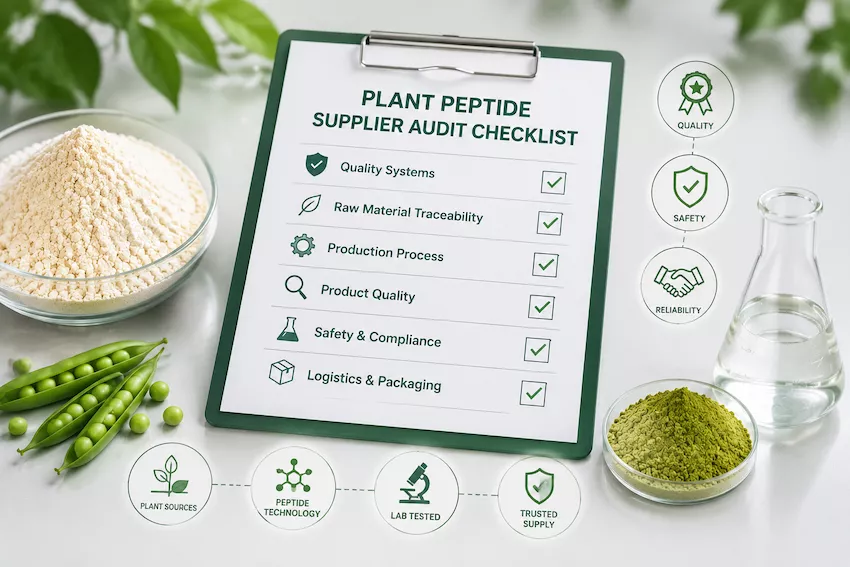
Active QMS certifications like cGMP and ISO standards guarantee baseline manufacturing safety.
Farm-to-factory documentation tracks specific plant species to ensure complete raw material purity.
Targeted enzymatic hydrolysis maintains small peptide sizes between 1,000 and 3,000 Daltons.
Specialized debittering treatments deliver neutral flavors and complete cold-water powder solubility.
Accredited ISO 17025 laboratories test every batch to screen for dangerous chemical contaminants.
Controlled cold storage and nitrogen-flushed packaging protect dry powders from destructive moisture.
Structured audit checklists evaluate supplier risks to defend brand quality and consumer safety.
Quality assurance teams initiate vendor evaluations by reviewing baseline Quality Management System (QMS) certifications. Suppliers must demonstrate active adherence to current Good Manufacturing Practices (cGMP), ISO 9001, and ISO 22000 standards. These certified frameworks ensure that manufacturing facilities maintain strict operational controls during plant protein peptide processing.
Valid QMS accreditations confirm that a manufacturing facility follows structured sanitation routines, precise equipment calibrations, and complete batch tracking protocols. Auditors verify active certificates directly with accredited issuing bodies. This systematic verification process eliminates regulatory compliance gaps before raw material purchasing commitments begin.
Standard supplier self-assessments rarely reveal hidden operational vulnerabilities within ingredient manufacturing facilities. Thorough technical evaluation requires unredacted third-party audit reports from recognized certification agencies. These independent audit documents provide transparent insights into daily operational compliance, batch controls, and facility hygiene standards.
A robust plant peptide supplier audit checklist requires suppliers to share these annual external audit reports transparently. Procurement managers examine audit findings across site sanitation, raw material storage, contamination controls, and analytical testing protocols. This detailed documentation review confirms vendor operational accountability and site readiness.
Plant-derived peptides enter global commercial markets with varying food safety regulations, labeling requirements, and import restrictions. A qualified ingredient vendor tracks regulatory changes continuously across target international regions, including North America, Europe, and Asia. This proactive alignment protects downstream brand owners from unexpected border holds, trade barriers, or costly distribution delays.
Regulatory compliance teams verify vendor suitability by auditing detailed ingredient specifications against regional food additive registries and novel food databases. Suppliers must provide comprehensive technical documentation supporting global commercial distribution rights. This technical diligence ensures smooth, compliant international market entry for finished functional foods, drinks, and dietary supplements.
Corrective and Preventive Action (CAPA) programs show how effectively an ingredient manufacturer resolves internal quality failures. Regulatory agencies prioritize CAPA logs during official facility inspections to evaluate quality system functionality. Poor CAPA management, such as leaving unresolved open items past 18 months, directly creates severe regulatory compliance risks and citations.
Quality assurance managers analyze historical non-conformance logs to evaluate root cause analysis depth and systemic corrective action timelines across facility operations.
Evidence Point | How it Improves Regulatory Compliance |
|---|---|
CAPA log focus | Regulators inspect logs to verify overall quality system functionality. |
Risk identification | Resolving open items prevents major regulatory citations during official inspections. |
Proactive prevention | Root cause fixes address systemic machine and material issues to stop recurrence. |
Quality assurance teams verify the botanical source before starting production. Manufacturers extract peptides from specific plant species, including seeds of pea, soybean, rice, wheat, corn, and walnut. Species identification testing confirms plant identity, ensuring the raw material contains predictable amino acid profiles.
Variations in plant organs alter functional peptide characteristics significantly. Pure seed protein isolates provide consistent starting materials for processing. Beyond Biopharma utilizes well-defined plant sources to establish reproducible batch chemistry across all botanical peptide lines.
Rigorous documentation tracks raw materials from agricultural fields to processing facilities. Complete farm-to-factory documentation records seed lot numbers, harvest dates, and shipping logs. Quality auditors inspect these chain-of-custody records to verify supply chain transparency.
Documented traceability impacts ingredient quality and brand value across several areas:
It mitigates contamination risks, supporting product safety and purity.
It enables brands to substantiate sustainability and ethical sourcing claims.
It provides transparent data that builds consumer trust.
It establishes a quality narrative connecting agricultural integrity to final product value.
Controlled enzymatic hydrolysis breaks down intact plant proteins into functional peptide fragments. Technicians monitor temperature, pH, and enzyme concentration continuously. Precise control over these processing parameters prevents protein denaturation while maximizing peptide yield.
Beyond Biopharma employs specialized exopeptidase treatments and a multi-stage debittering process. This targeted enzymatic breakdown removes bitter amino acid tails and eliminates gritty texture without heavy masking agents. Consequently, the final peptide powder delivers a neutral taste profile and complete cold-water solubility.
Low molecular weight distribution ensures rapid absorption and enhanced bioactivity. Quality assurance laboratories analyze finished peptide batches using liquid chromatography. This analytical testing confirms that short-chain peptides consistently fall within the target 1,000–3,000 Da range.
Uncontrolled hydrolysis creates variable peptide lengths that disrupt functional performance. Consistent molecular weight distribution guarantees predictable viscosity and bioactivity in beverage formulations. Beyond Biopharma validates this mass distribution for every batch.
Cross-contamination during handling threatens finished product safety and clean-label claims. Processing facilities use dedicated production lines and verified cleaning procedures between operational runs. Suppliers offer non-GMO declarations to prove raw material purity.
Allergen isolation protocols protect consumers from unintended cross-contact risks. Beyond Biopharma provides naturally hypoallergenic options, including pea and rice protein peptides, for sensitive applications. Dedicated allergen control programs safeguard product integrity across manufacturing steps.
Quality assurance teams verify peptide purity through advanced testing workflows. Laboratories run reversed-phase High-Performance Liquid Chromatography (HPLC) with UV detection at 215 nm to separate active peptides from modified impurities.
Testing facilities couple HPLC with Electrospray Ionisation Mass Spectrometry (ESI-MS) to verify molecular identity. ESI-MS measures the exact mass-to-charge ratio against target theoretical values. Tandem Mass Spectrometry (MS/MS) fragments peptides to generate b- and y-ion ladders, confirming the amino acid sequence.
Manufacturers validate every production batch with a comprehensive Certificate of Analysis (CoA). Testing conducted inside ISO 17025 accredited laboratories guarantees technical competence and analytical precision. Independent laboratory validation confirms batch conformity before commercial distribution.
Beyond Biopharma supplies batch-specific CoAs alongside technical documentation packages for every order. These documents detail molecular weight distribution curves, protein content, and analytical purity metrics. Downstream formulators rely on this verifiable testing data to ensure consistent finished product performance.
Ingredient safety protocols establish strict threshold checks across all chemical hazards. Quality assurance laboratories screen plant peptide lots for residual solvents, pesticides, mycotoxins, and heavy metals, including lead, arsenic, cadmium, and mercury.
Beyond Biopharma enforces stringent purity thresholds across every plant protein peptide line. This rigorous chemical surveillance protects finished supplements and beverages against hidden agricultural contaminants.
Microbiological safety requires continuous monitoring throughout processing. Quality control teams sample finished powders to measure total aerobic microbial counts, yeast levels, and mold populations. Pathogen screening verifies complete absence of Salmonella, Escherichia coli, and Staphylococcus aureus.
Clean production environments prevent bioburden accumulation during packaging steps. Environmental monitoring programs track airborne particles and surface cleanliness within facilities. Controlled microbial management safeguards consumer health and extends shelf life.
Stability testing programs demonstrate how peptide ingredients behave under environmental stress. Suppliers store test batches in climate chambers to gather accelerated and real-time degradation data. Testing protocols measure changes in cold-water solubility, powder color, and pH balance over time.
Accelerated stability studies expose samples to elevated temperature and humidity conditions. These stress tests prove physical powder stability, low moisture absorption, and functional profile retention. Formulators use stability data to establish valid shelf-life declarations for clear drinks.
Global food and nutraceutical brands often require specialized testing criteria for unique applications. Flexible suppliers accommodate custom client specifications, including tight particle size distributions. Quality assurance teams adjust standard protocols to fulfill specific commercial requirements.
Beyond Biopharma supports tailored analytical testing parameters for specialized client formulations. Technical specialists collaborate with customer quality teams to verify specific solubility limits, bulk density targets, and organoleptic parameters. Custom CoA profiles facilitate smooth ingredient integration into manufacturing operations.
Quality assurance teams evaluate a vendor's total production throughput to verify long-term supply resilience. Modern peptide manufacturing platforms integrate continuous processing technology alongside Process Analytical Technology (PAT). This advanced setup maintains precise stoichiometric control during enzymatic hydrolysis, reducing batch variability and setup cycles. High-capacity facility infrastructure guarantees stable raw material delivery for global distribution networks.
Procurement managers confirm annual throughput parameters to prevent sudden supply chain bottlenecks. Facilities with scalable manufacturing lines easily accommodate expanding commercial orders for sports nutrition and functional food brands. Beyond Biopharma operates high-capacity production systems designed for rapid output. Strong production scalability allows downstream partners to launch large commercial product runs without risk of material shortages.
Rigorous equipment hygiene protocols protect plant protein peptide powders from microbioburden accumulation. Production facilities validate Clean-In-Place (CIP) systems through Installation Qualification (IQ), Operational Qualification (OQ), and Performance Qualification (PQ). Processing machinery features 316L SS construction to prevent metal corrosion and facilitate thorough chemical sanitation cycles.
Automated CIP datalogs capture flow, temperature, and conductivity metrics according to FDA 21 CFR Part 11 standards.
Analytical testing of rinse samples confirms cleaning efficacy before new batch cycles begin. Facilities enforce strict microbial limits, maintaining Total Aerobic Microbial Count at TAMC≤200 CFU/g and Total Yeast and Mold Count at TYMC≤50 CFU/g. Validated cleaning protocols effectively eliminate allergen residues and prevent batch-to-batch cross-contamination.
Physical quality metrics define the functional utility of plant-derived peptides in commercial formulas. High-grade plant protein peptides achieve complete 100% cold-water solubility without leaving grit, cloudiness, or heavy sediment. Finished powders must maintain exceptional visual clarity and pH stability across diverse finished applications, including clear protein waters, ready-to-drink beverages, and functional bakery items.
Organoleptic testing panels evaluate powder color and flavor uniformity across separate manufacturing lots. Advanced multi-stage debittering processes and exopeptidase treatments strip away naturally bitter botanical attributes. This targeted processing yields a completely neutral taste profile. Downstream formulators can fortify products with high peptide doses without adding heavy masking agents.
Predictable biological activity requires absolute control over peptide chain length. Beyond Biopharma monitors enzymatic hydrolysis reactions continuously to ensure molecular weight distribution remains within the optimum 1,000–3,000 Da window. Quality control specialists employ High-Performance Liquid Chromatography (HPLC) according to USP <621> standards to confirm peptide purity levels of ≥95%.
Beyond Biopharma sets an industry benchmark for uniform batch-to-batch organoleptic and functional profiles. Standardized raw material selection and tightly controlled processing parameters maintain reproducible amino acid profiles across all production runs. Downstream brands receive highly bioavailable, easily digestible peptides that deliver consistent nutritional performance in every single batch.
High-barrier packaging materials protect plant protein peptides from atmospheric moisture during storage. Hydrolyzed plant peptides naturally absorb environmental humidity, which triggers rapid powder clumping and physical degradation. Packaging engineers specify multi-layer flexible films to maintain very low water vapor transmission rates.
Packaging Layer Structure | Primary Protective Benefit |
|---|---|
PET/AL/PE | Aluminum foil layer delivers maximum moisture and light protection. |
PET/VMPET/PE | Metallized film provides high moisture barrier with lower overall weight. |
Mono-PE | High-barrier recyclable mono-material supports clean-label sustainability. |
Packaging facilities purge container headspaces with nitrogen gas right before sealing. Nitrogen displacement eliminates residual oxygen, which prevents oxidative degradation pathways in stored peptides. Furthermore, using FDA-certified, BPA-free PETG plastic or foil containers protects light-sensitive bioactive sequences. Secure heat seals isolate dry peptide powders from fluctuating humidity levels across external supply chains.
Maintaining plant peptides in a lyophilized dry powder format minimizes hydrolysis and maximizes ingredient shelf life. Warehouse management teams maintain strict environmental parameters inside raw material storage rooms. Cold storage settings at 2–8°C or -20°C suppress chemical reaction rates and preserve functional protein attributes over extended storage periods.
Store dry powders in modular trays containing 50-100 units to organize bulk inventory efficiently.
Add structural stabilizers like polyols, sucrose, or mannitol to reduce chemical degradation pathways.
Aliquot bulk lots into smaller working units to avoid repeated freeze-thaw cycles during sampling operations.
Color-coded storage vaults streamline daily raw material identification while keeping inventory organized. Stacking modular trays inside climate-controlled facilities optimizes cold storage space without placing excessive physical stress on bottom containers. These controlled storage protocols maintain consistent peptide solubility, powder flowability, and functional bioactivity for global downstream manufacturing operations.
Logistics providers enforce strict environmental monitoring protocols during long-distance transit. Freight forwarders utilize hardshell Ethylene Vinyl Acetate (EVA) cases with insulated liners to absorb physical shocks during small-batch transport. Transport vehicles maintain continuous climate control to defend cargo against extreme external weather conditions.
Integrated electronic dataloggers sit inside shipping containers to record internal ambient temperature and relative humidity levels continuously. Shipping coordinators download these digital transit logs upon arrival at client facilities to verify complete supply security. Verifiable transit records confirm that shipment temperatures remained within safe regulatory thresholds, ensuring pristine material performance upon arrival.
Manufacturing modifications alter the physical structure and functional performance of bioavailable plant peptides. Quality control teams evaluate any operational shift in enzyme selection, botanical species origin, or hydrolysis temperature settings before commercial release. A strict change control policy obligates vendors to issue formal advance change notifications to commercial customers prior to implementing process alterations.
International regulatory authorities establish standard framework requirements to manage technical process adjustments. Suppliers implement three core guidelines from the International Council for Harmonisation (ICH) to control operational modification risks:
ICH Q9 (Quality Risk Management) governs the systematic assessment and management of risks associated with process modifications, ensuring changes are evaluated for potential impact on quality.
ICH Q10 (Pharmaceutical Quality System) establishes the formal Pharmaceutical Quality System, which includes the essential element of change management and control, providing the structured process for proposing, reviewing, approving, and implementing modifications.
ICH Q5E (Comparability of Biotechnological/Biological Products) provides the specific methodology for demonstrating that a product is comparable before and after a manufacturing process change, directly addressing the risk that modifications may adversely affect product quality.
Reliable commercial delivery protects downstream brand owners against costly assembly line shutdowns and stockout events. Procurement teams evaluate vendor supply chain resilience by auditing standard order lead times, minimum order quantities (MOQs), and dedicated warehouse safety stocks. Robust suppliers hold reserved buffer inventories of active plant protein peptides to absorb sudden spikes in market demand.
Adding these commercial logistics metrics into a plant peptide supplier audit checklist guarantees long-term supply chain security for beverage and supplement manufacturers. Beyond Biopharma establishes predictable fulfillment schedules and customized MOQ structures for expanding global brands. Continuous inventory tracking ensures raw material availability across routine production cycles.
Unintended quality deviations require rapid resolution protocols to protect manufacturing schedules. Ingredient vendors maintain structured standard operating procedures to handle off-specification deliveries, damaged packaging, or analytical testing failures. Quality managers quarantine non-conforming material immediately upon arrival to prevent accidental batch contamination inside production facilities.
Quality assurance agreements define official dispute investigation timelines, corrective action plans, and material replacement procedures. Suppliers issue immediate replacement lots or commercial credits following formal root cause verification. Clear non-conformance protocols uphold operational accountability between ingredient suppliers and downstream product manufacturers.
Quality assurance teams evaluate audit responses through a structured risk-scoring matrix. Quality managers categorize identified operational gaps into critical red flags or minor discrepancies to determine overall vendor suitability. Critical non-conformances include unverified botanical origins, missing cGMP certifications, active microbial contamination, or uncontrolled molecular weight profiles exceeding 3,000 Da. These critical failures trigger immediate vendor disqualification because they compromise finished product safety, physical beverage clarity, and global regulatory compliance. Procurement specialists never compromise on these fundamental quality metrics.
Conversely, minor discrepancies represent lower-risk operational gaps that suppliers can rectify through formal corrective action plans. Minor issues include simple typographical errors on technical data sheets, minor layout changes on packaging labels, or slight delays in annual documentation updates. Quality auditors assign weighted numerical scores across all twenty-five survey items, establishing a transparent passing threshold for final vendor qualification. Implementing a structured plant peptide supplier audit checklist provides quality teams with an objective framework for evaluating ingredient safety.
Non-Conformance Category | Risk Severity | Operational Example | Required Corrective Action |
|---|---|---|---|
Critical Red Flag | High Risk | Pathogen detection or missing cGMP certification | Immediate vendor disqualification |
Minor Discrepancy | Low Risk | Typographical error on specification document | Corrective Action Plan (CAPA) within 30 days |
Beyond Biopharma simplifies ingredient qualification by satisfying all parameters on the plant peptide supplier audit checklist. Processing facilities operate under validated cGMP, ISO 9001, and ISO 22000 quality management systems. Modern farm-to-factory tracking protocols guarantee complete raw material traceability across all botanical lines. Precision enzymatic hydrolysis parameters yield clean, low-molecular-weight short-chain peptides falling reliably within the optimum 1,000–3,000 Da window. ISO 17025 accredited testing laboratories run High-Performance Liquid Chromatography to verify sequence purity and mass distribution profiles for every batch.
Beyond Biopharma offers a comprehensive ingredient portfolio including hydrolyzed pea, soybean, rice, wheat, corn, and walnut peptides. Specialized multi-stage debittering processes and targeted exopeptidase treatments eliminate natural botanical bitterness, off-flavors, and gritty textures completely. Consequently, these premium peptides achieve complete 100% cold-water solubility without leaving cloudiness, grit, or sediment in liquid formulations. Formulators fortify sports nutrition recovery drinks, clear protein waters, clinical nutrition products, and plant-based food alternatives effortlessly without adding heavy taste-masking agents.
Beyond Biopharma supplies batch-specific Certificates of Analysis and comprehensive technical documentation packages with every order, streamlining vendor onboarding and protecting downstream brand performance.
A structured plant peptide supplier audit checklist protects finished product quality, consumer safety, and commercial brand integrity. Quality assurance teams eliminate severe operational risks by standardizing vendor evaluations across critical processing parameters. Successful raw material qualification relies on four core technical pillars: verifiable molecular weight profiles between 1,000–3,000 Da, complete cold-water solubility, neutral taste, and transparent regulatory documentation.
Beyond Biopharma delivers fully audited Plant Protein Peptides that fulfill every quality parameter across all production batches. Procurement leaders should partner with Beyond Biopharma today to secure premium botanical peptides, streamline supplier onboarding, and optimize finished product performance across global commercial markets.
This low molecular weight range guarantees rapid human digestive absorption and superior bioavailability. Furthermore, small peptide chains prevent beverage cloudiness and maintain stable viscosity in finished liquid formulations.
Beyond Biopharma manufactures hydrolyzed pea, soybean, rice, wheat, corn, and walnut peptides. The production facility maintains complete farm-to-factory raw material traceability across all these botanical sources.
Targeted exopeptidase treatments and controlled enzymatic hydrolysis break large protein structures into low-molecular-weight fractions. This specialized processing eliminates sediment, grit, and cloudiness in liquid applications.
A multi-stage debittering process removes bitter hydrophobic amino acid tails during hydrolysis. This enzymatic treatment creates a neutral flavor profile without requiring heavy masking agents.
cGMP, ISO 9001, and ISO 22000 standards certify the manufacturing facilities. Additionally, ISO 17025 accredited laboratories perform independent testing to issue batch-specific Certificates of Analysis.
Beyond Biopharma produces naturally hypoallergenic options, including pea and rice protein peptides. Strict allergen isolation protocols and validated clean-in-place procedures prevent cross-contamination during production runs.


Tel:+86 21 65010906
Cell/Whatsapp/Wechat:
+86 13482884055
+86 18657345785
Email: sales@beyondbiopharma.com





 English EN


