Key Steps in the Manufacturing of Collagen: From Raw Material to Finished Product
Sourcing high-quality collagen peptides or gelatin for your next product launch often comes down to one thing: batch consistency. Whether you are a nutraceutical R&D manager or a pharmaceutical excipient buyer, understanding the manufacturing process of collagen helps you evaluate suppliers and avoid common pitfalls like off-odor, poor solubility, or certification gaps. This article walks you through the key production stages, from raw material selection to finished powder, with practical spec guidance and sourcing tips for overseas buyers.
What Is Collagen and Why Does Manufacturing Consistency Matter?
Collagen is the most abundant structural protein in animals, commonly extracted from bovine hide, bovine bone, porcine skin, or fish scales and skin. For ingredient buyers, the manufacturing process directly determines key quality markers such as gel strength (Bloom), molecular weight distribution, solubility, and odor profile. A reliable supplier controls every step to ensure each batch meets your target specifications.
How Is Collagen Manufactured? A Step-by-Step Overview
The production of collagen ingredients, whether gelatin or collagen peptides, follows a controlled sequence. Understanding these steps helps you ask the right questions when sourcing.
- Raw material selection and pretreatment: Clean, inspected hides, bones, or fish skins are washed, cut, and treated with dilute acid or alkali to remove non-collagenous proteins and minerals. For bovine bone gelatin, BSE-free certification is critical.
- Extraction (hydrolysis): The prepared raw material is heated with water under controlled temperature and pH. For gelatin, this yields a high-molecular-weight protein solution. For collagen peptides, enzymatic hydrolysis further breaks down the protein into smaller fragments (typically 2,000–5,000 Da).
- Filtration and purification: The extract passes through filter presses, ion-exchange columns, and activated carbon to remove impurities, fats, and color bodies. This step is key for low-odor and high-clarity products.
- Concentration and sterilization: The purified solution is concentrated via evaporation and then flash-pasteurized or UHT-treated to ensure microbiological safety.
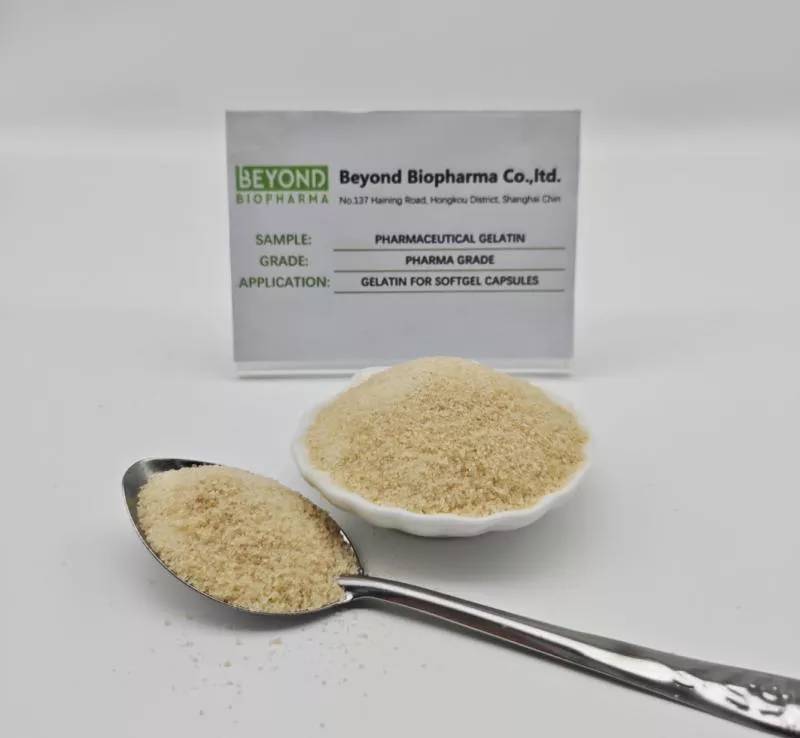
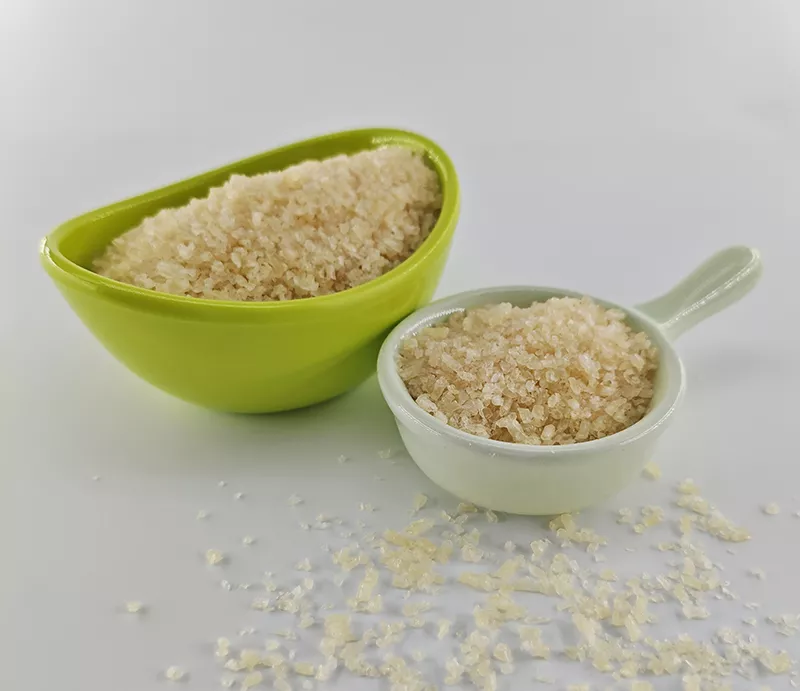
- Drying and milling: The liquid is dried on a drum dryer or spray dryer into sheets, granules, or powder. Milling and sieving control the final mesh size (e.g., 8–60 mesh for gelatin, finer for peptides).
- Blending and quality testing: Each lot is tested for Bloom, viscosity, pH, moisture, heavy metals, and microbial counts before release. A Certificate of Analysis (COA) accompanies every shipment.
What Are the Typical Specifications for Collagen and Gelatin?
The table below summarizes common industry parameter ranges. Note: these are typical ranges; final values should be confirmed per supplier COA and sample.
| Parameter |
Edible Gelatin |
Collagen Peptide |
Plant Protein Peptide |
| Bloom (g) |
50–300 (pharma/gummies: 150–260) |
N/A (non-gelling) |
N/A |
| Molecular Weight (Da) |
~50,000–200,000 |
2,000–5,000 (fish typically lower) |
Commonly <5,000 |
| Protein Content (%) |
≥85 |
≥90 |
80–90 |
| Viscosity (mPa·s) |
2.0–5.5 |
Low |
Low |
| Mesh Size |
8–60 |
20–80 |
30–80 |
| Moisture (%) |
≤14 |
≤8 |
≤8 |
Typical industry range; final values per COA / sample.
How Do Different Applications Influence Your Collagen Selection?
Choosing the right collagen ingredient depends on your final product form and target market. Below are common applications and recommended solutions.
Why Beyond Biopharma for Your Collagen Supply?
Beyond Biopharma is a Shanghai, China–based manufacturer specializing in collagen peptides, gelatin, and plant protein peptides. With over 10 years in the food-ingredient industry, we export to more than 50 countries. Our facility has an annual capacity of approximately 3,000 MT for collagen and 5,000 MT for gelatin, supported by a fully automatic production line, GMP clean workshop, stainless-steel sealed piping, and automated temperature/pH control. We hold ISO 9001 certification, US FDA registration, and select products carry Halal or Kosher certification (e.g., fish gelatin). Our bovine bone gelatin is BSE-free. An in-house lab performs heavy-metal and microbiological testing, and a dedicated QA/QC team ensures every batch meets your specs. We offer three grades: food, pharmaceutical, and cosmetic, plus free samples and formulation support.
Frequently Asked Questions
Q: What is the difference between gelatin and collagen peptide?
A: Gelatin is partially hydrolyzed collagen with high molecular weight (50,000–200,000 Da) and forms a gel. Collagen peptide is more fully hydrolyzed (2,000–5,000 Da), does not gel, and dissolves easily in cold water for faster absorption.
Q: How do I choose between fish and bovine collagen peptide?
A: Fish collagen peptide typically has a lower molecular weight and is preferred for skin health and faster absorption. Bovine collagen peptide is often used in bars, powders, and general nutrition. Both are available as alternatives to brands like Peptan or Verisol.
Q: What certifications should I look for in a collagen supplier?
A: Key certifications include ISO 9001, US FDA registration, GMP, Halal, Kosher, and BSE-free documentation for bovine products. Beyond Biopharma holds these and provides COAs for each batch.
Q: Can I get a sample before placing a bulk order?
A: Yes. Beyond Biopharma offers free samples for evaluation. You can request a sample by providing your application, required grade, and target specs.
Q: What is the minimum order quantity (MOQ) for collagen peptides?
A: MOQ varies by product and grade. Contact Beyond Biopharma with your volume requirements and destination country for a tailored quote.
Q: How do you ensure low odor and high solubility in collagen peptides?
A: Low odor and high solubility are achieved through strict raw material selection, thorough purification (filtration, ion exchange, activated carbon), and controlled enzymatic hydrolysis. Our in-house lab tests each batch for these quality markers.
Request a Quote and Free Sample
Ready to source collagen or gelatin for your next formulation? Tell us about your project. Please include your application, required grade (food, pharmaceutical, or cosmetic), quantity/MOQ, target specs (Bloom, mesh, molecular weight, certifications), and destination country. Beyond Biopharma will send free samples and a competitive quote. We look forward to supporting your product development with consistent, high-quality collagen ingredients.
 English EN








User Comments
Service Experience Sharing from Real Customers
Maggie
Senior R&D ChemistI've been sourcing raw materials for our nutraceutical line for over a decade, and this collagen manufacturing process is genuinely impressive. The peptide profile is consistent batch to batch, and the solubility in cold water is a huge win for our production team. We switched six months ago and haven't had a single gelation issue.
Leo
Production Line OperatorHonestly, I was skeptical at first because we've tried a few different suppliers. But this stuff runs through our mixing tanks without clumping, and cleanup is way easier. The only reason I'm not giving five stars is that the shipping pallets could be sturdier—had one corner crushed last week, but the bags inside were fine.
Priya
Quality Assurance ManagerWe run heavy metal and microbiological tests on every incoming lot, and this collagen has passed with flying colors every single time. The documentation is thorough, and the COAs are always ready before the shipment arrives. It's rare to find this level of consistency from a contract manufacturer.
Tomás
Formulation ScientistI needed a hydrolyzed collagen that would play nice with a high-concentration vitamin C serum without precipitating out. This one worked beautifully. The particle size distribution is narrow, which makes dispersion predictable. Took off one star because the lead time stretched a bit during the holiday rush, but the quality is solid.