
EN
Achieving batch to batch consistency protein peptide manufacturing requires establishing strict Critical Quality Attributes (CQAs), standardizing multi-source raw materials, tightly controlling enzymatic hydrolysis, and employing normalized proteomic analytics. Botanical raw materials present inherent natural variations. Changes in soil, climate, and harvesting seasons alter native plant protein structures. Process engineers must eliminate these downstream variations during commercial scale-up. Commercial applications demand identical functional performance across every production lot. Formulation scientists rely on precise molecular weight distributions to guarantee 100% cold-water solubility, rapid digestion, and complete lack of sedimentation. Advanced processing methods eliminate bitter off-flavors, securing a neutral taste profile without heavy masking agents. Systematic process controls ensure uncompromised bioactivity and target performance at scale.
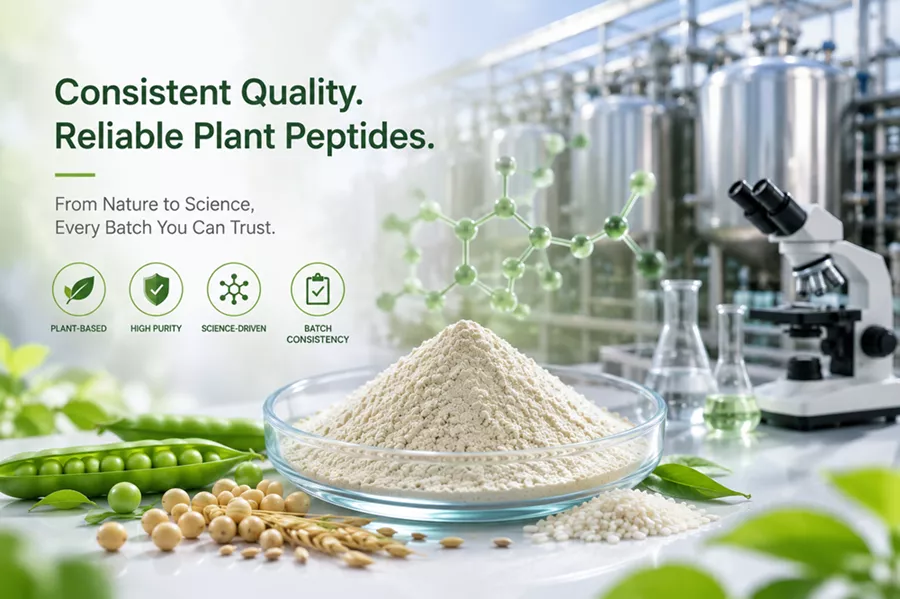
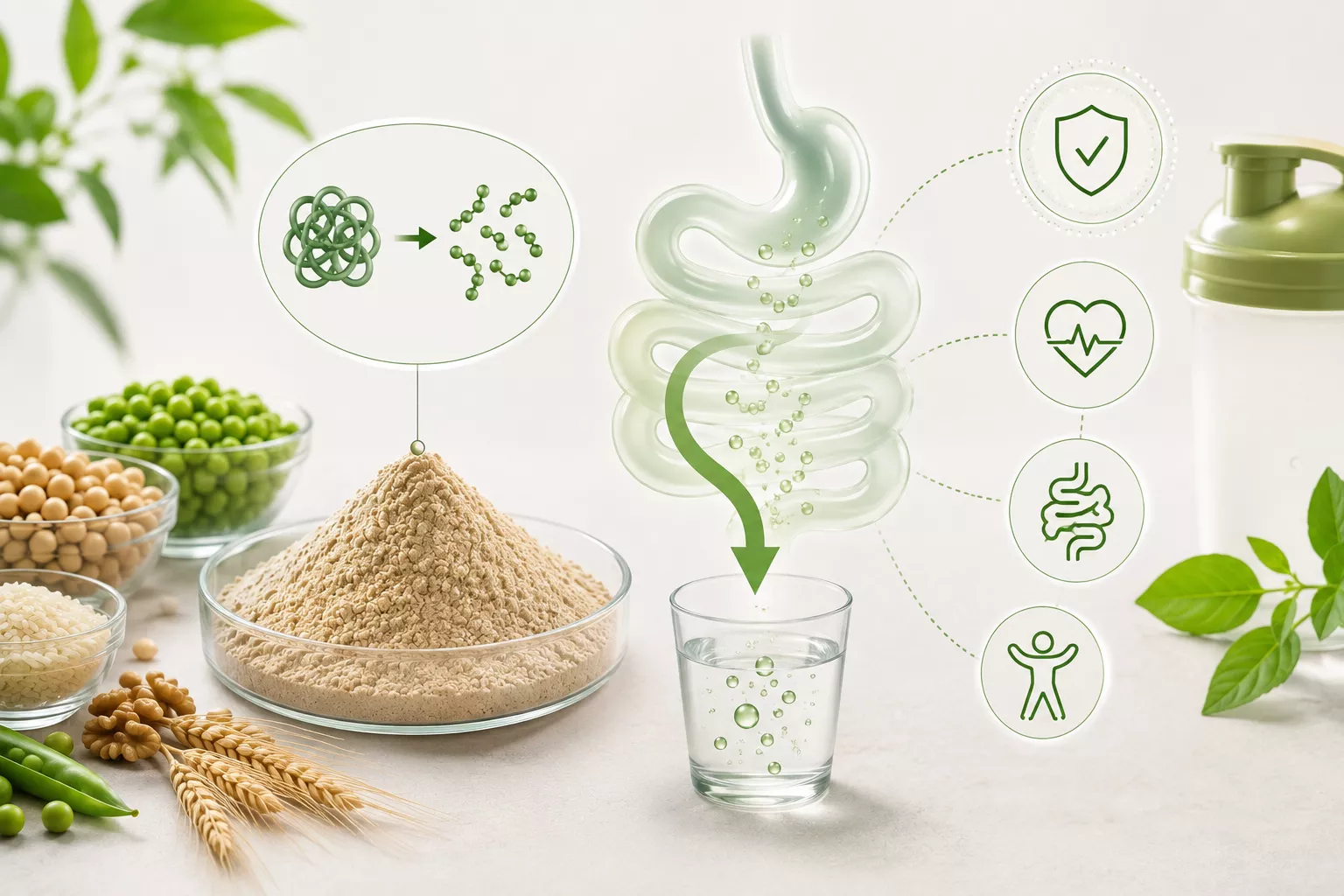
Process engineers establish strict baseline Critical Quality Attributes (CQAs) to ensure product uniformity across all commercial manufacturing runs. Molecular weight distribution directly dictates cellular absorption speeds, physiological responses, and systemic bioactivity. Raw plant protein isolates contain large, complex polypeptide chains. Automated processing facilities must break down these native structures into precise low molecular weight peptide fractions. Technical teams target a narrow size range between 1,000 and 3,000 Da. This specific molecular window provides optimum functional characteristics for high-performance end products.
Standardizing this narrow size range guarantees rapid gastrointestinal digestion in final consumer applications. Short amino acid chains within the 1,000 to 3,000 Da window pass through human digestive pathways efficiently. Precise cleavage prevents batch-to-batch molecular weight drift during full-scale factory production. Consistent molecular weight control retains active peptide sequences across every commercial lot. Formulators obtain uniform bioactivity, reliable cellular uptake, and steady nutritional results in every commercial shipment.
Functional performance depends on total physical stability across different beverage and food liquid matrixes. Quality assurance teams set rigid baselines requiring 100% cold-water solubility for all incoming lots. Technicians dissolve peptide samples into low-temperature liquid solutions to observe real-time dissolution kinetics. Optical density tests verify solution clarity and confirm the absolute lack of sedimentation or residual cloudiness. The peptide solution must remain fully dissolved without forming precipitates during extended shelf-life storage periods.
Controlled enzymatic cleavage destroys hydrophobic regions to minimize native bitter off-flavors. Effective debittering processing allows high-dose peptide inclusions in commercial food and beverage products without heavy flavor-masking agents. Product developers establish strict organoleptic baselines alongside these physical solubility parameters. Analytical testing protocols map bioactivity markers against verified reference samples. Systematic baseline mapping guarantees consistent functional performance across clear sports recovery drinks, clinical nutrition formulas, and functional food applications.
Process engineers must standardize incoming botanical isolates across six primary plant sources: pea, soybean, rice, wheat, corn, and walnut. Each botanical species presents distinct native protein profiles, varied peptide bond arrangements, and different initial molecular weights. Quality control teams implement rigorous intake screening protocols for every incoming isolate shipment. These standardized inspection procedures measure native protein purity, ash content, and initial solubility parameters before raw materials enter active production lines. Standardized feedstocks ensure smooth processing through downstream hydrolysis tanks.
Manufacturers adjust raw material handling strategies to match the specific physical and functional properties of each plant species. Product developers choose hypoallergenic options like pea and rice proteins to avoid common major allergens while maintaining clean-label product positioning. Production facilities processing wheat and corn isolates optimize extraction steps to preserve high glutamine concentrations for muscle recovery formulations. Soybean and walnut isolates require targeted lipid extraction steps to eliminate potential off-flavors and preserve long-term storage stability. Customized intake steps ensure optimal functional performance across all finished peptide applications.
Variable agricultural growing conditions create natural composition shifts in raw crop harvests. Regional soil quality, annual rainfall variations, and temperature fluctuations alter native protein yields across different farm regions. Quality assurance technicians perform analytical testing on every incoming agricultural lot. Testing protocols determine total protein content, moisture percentages, and baseline amino acid distributions to identify raw material variations early. Early detection of raw material variance protects downstream enzymatic digestion from unexpected delays.
Production teams neutralize geographic and seasonal raw material shifts before enzymatic hydrolysis processing starts. Facilities utilize controlled batch-blending methods, mixing analyzed agricultural lots to create uniform starting feedstocks. This precise raw material blending stabilizes substrate concentrations across every manufacturing run. Systematic raw material standardization prevents operational drift, keeps enzymatic digestion kinetics predictable, and guarantees batch-to-batch consistency for full-scale commercial manufacturing. Consistent feedstocks protect final product performance and support seamless commercial scale-up.
Advanced controlled enzymatic hydrolysis breaks native plant protein structures down into specific short amino acid chains. Industrial processing facilities use specialized enzymes to cleave large, complex polypeptide molecules into functional peptide fractions. Specific endopeptidases and exopeptidases target distinct peptide bonds along the plant protein backbone. Targeted bond cleavage releases consistent amino acid sequences across every production cycle. Precise control over enzyme cleavage sites creates reproducible peptide profiles from complex botanical isolates. Process engineers closely regulate digestion kinetics to maintain consistent molecular sizes. Uncontrolled hydrolysis causes wide molecular weight distributions across finished processing lots. Variable cleavage kinetics disrupt product bioactivity, solubility, and overall functional performance. Automated dosing systems feed enzymes gradually into processing vessels to ensure uniform enzymatic dispersion.
Engineering teams control reaction variables to ensure repeatable peptide bond cleavage across all batches. Technicians regulate enzyme-to-substrate ratios precisely before starting reactor agitators. Fixed enzyme concentrations keep reaction speeds steady across different production shifts. Proper cleavage kinetics preserve ideal low molecular weight distributions between 1,000 and 3,000 Da. Consistent molecular size profiles guarantee rapid intestinal absorption and steady nutritional benefits for end consumers. Reliable cleavage kinetics support efficient commercial scale-up while maintaining high product quality standards. Process control software tracks cleavage rates in real time during production runs. Proper kinetic management helps achieve batch to batch consistency protein peptide manufacturing across all commercial production lines.
Enzyme activity depends heavily on specific environmental conditions inside large stainless steel hydrolysis tanks. Automated processing systems continuously monitor and control physical parameters throughout the digestion reaction window. Industrial facilities utilize targeted control mechanisms to stabilize digestion environments:
Jacketed thermal heating loops maintain precise slurry temperatures inside processing tanks.
Automated dosing pumps inject food-grade acids or bases to stabilize slurry pH levels continuously.
Agitation impellers spin at regulated speeds to distribute enzymes uniformly through the substrate matrix.
Inline density sensors track fluid viscosities to measure hydrolysis progress and reaction depth continuously.
Small shifts in processing temperatures or pH levels alter enzyme reaction speeds immediately. Sub-optimal reaction conditions cause incomplete protein breakdown or unwanted over-hydrolysis. Over-hydrolysis cuts short peptide chains into individual hydrophobic amino acids. Exposed hydrophobic groups create strong bitter off-flavors in finished peptide ingredients. Over-digestion destroys functional bioactive sequences and causes molecular weight drift below target performance specifications. Precise environmental monitoring prevents enzyme denaturation during critical hydrolysis stages. Tight parameter control prevents off-flavor formation and guarantees neutral taste profiles without chemical masking agents.
Processing systems require immediate, precise reaction termination protocols to lock in critical quality attributes. Technicians stop enzymatic activity instantly once the target hydrolysis degree occurs. Thermal inactivation systems pump peptide slurries through high-temperature short-time heat exchangers. High thermal exposure permanently denatures enzyme proteins without damaging short peptide chains. Alternative chemical inactivation methods shift tank pH values outside active enzyme functional ranges when thermal processing is unavailable. Rapid enzyme termination freezes the molecular weight distribution at target levels. Immediate reaction termination eliminates molecular weight drift between manufacturing shifts. Standardized termination protocols preserve cold-water solubility, neutral taste profiles, and target bioactivity across all commercial production lots.
Scaling plant peptide production from small trial setups to full commercial lines introduces physical processing challenges. Engineers must control fluid behavior and environmental factors inside industrial processing vessels. Proper scale-up strategies lock in critical quality attributes like dissolution profiles, particle size distribution, and impurity levels across every production run.
Transitioning a liquid process from a 50L pilot reactor to a 1000L commercial vessel alters internal fluid hydrodynamics and cooling rates. Changes in the Reynolds number and power per volume alter local mixing speeds inside large tanks. These hydrodynamic shifts can generate unexpected impurity profiles without precise control. Process engineers adjust agitation speeds and optimize fluid addition rates to maintain ideal mass transfer across the entire fluid volume. High-performance production facilities utilize integrated heating systems to keep mobile phases and process liquids at uniform operational temperatures.
Equipment Design Feature | Optimization Mechanism | Production Benefit |
|---|---|---|
Integrated Heating System | Uniformly heats mobile phases and processing tanks | Eliminates thermal mismatch and improves separation efficiency |
Elevated Temperature Operation | Enhances hydrophobic peptide solubility and kinetic rates | Improves peak shapes, fraction purities, and peptide recovery rates |
Focused Gradient Calculator Software | Converts analytical runs directly to preparative scale | Eliminates scouting runs and maintains method consistency |
Technicians deploy in-line Process Analytical Technology tools inside reaction vessels. Focused beam reflectance measurement probes monitor chord length distribution in real time during active processing. Real-time solubility data allows engineers to adjust anti-solvent addition rates immediately. These automated adjustments control liquid supersaturation during scaling steps. Elevated operational temperatures increase the overall solubility of hydrophobic plant peptides. Higher liquid temperatures lower system backpressure and allow higher flow rates. Advanced focused gradient calculator software converts small analytical runs into full preparative methods automatically. These modern technologies deliver reliable batch to batch consistency protein peptide output across three consecutive qualification batches.
Mechanical stress during fluid pumping and mixing damages delicate peptide chains during scale-up runs. High shear forces cause structural protein unfolding and expose hydrophobic amino acid regions. Unfolded peptides clump together into insoluble aggregates during processing. Shear forces also wear down equipment seals, flexible tubing, and agitator impellers over time. Mechanical wear introduces particulate contaminants into process streams and reduces product purity. Severe fluid turbulence creates cavitation and air bubbles inside transfer lines. Microscopic air bubbles generate visible and subvisible particles that ruin overall batch uniformity.
Engineers select low-shear pumps to transfer plant peptide slurries without damaging molecular structures. Peristaltic pumps, diaphragm pumps, and gentle rotary lobe pumps move delicate liquids safely through processing loops. Technical teams eliminate narrow flow paths and avoid sudden directional changes in factory piping layouts. Operators reduce unnecessary fluid recirculation steps to prevent material shedding inside tanks. Process engineers execute Design of Experiments studies inside scale-down models to map load density, flow rate, and pH interactions. Establishing a robust proven acceptable range for processing steps eliminates impurity spikes and increases overall yield by 12%. Monitoring flow loops with subvisible particle analyzers prevents batch rejection and guarantees batch to batch consistency protein peptide performance at full commercial scale.
Analytical teams use bottom-up proteomic techniques to verify exact peptide mapping across production lots. Reverse-phase high-performance liquid chromatography (HPLC) separates short amino acid chains to create a distinct lot fingerprint. Quality control technicians track target peptide sequences using liquid chromatography-tandem mass spectrometry (LC-MS/MS). This method confirms consistent bond cleavage across every processing batch. Analysts compare incoming chromatograms against verified reference standards to ensure structural uniformity.
Parameter | Standard Configuration for Reproducible Peptide Analysis |
|---|---|
Column Type | C18 silica (hydrophobic, reverse-phase) |
Mobile Phase | Water-acetonitrile gradient with 0.1% trifluoroacetic acid (TFA) |
Detection Wavelength | 214 nm or 220 nm (targets peptide bond absorption) |
Primary Output | Chromatogram showing peaks at specific retention times |
Key Capability | Provides a reproducible fingerprint of a synthesis batch |
Advanced ultra-performance liquid chromatography systems increase analytical precision across commercial runs. Testing protocols set the column temperature to 55°C and maintain the sample temperature at 5°C. Studies using specialized phenyl hexyl columns demonstrate strong quantitative reproducibility across separate packing material lots. These methods achieve a relative standard deviation (RSD) of ≤0.5% for absolute retention times. Peak area variations remain near 5% RSD, while critical impurity pair resolution stays below 4% RSD.
Quality control laboratories must isolate true production variance from non-biological technical noise. Technicians spike stable isotope-labeled protein internal standards into samples at the start of the workflow. Adding standards early corrects processing variations during protein extraction, digestion, injection, and ionization. Post-column infusion studies map ion suppression zones across the chromatographic run. Analysts adjust the liquid gradient to move target peptides into safe elution windows away from suppression zones.
Advanced mass spectrometers improve signal sensitivity and reduce quantitative errors. Systems featuring specialized ion traps enhance the duty cycle to ≥90%. This increase reduces ion transmission loss compared to traditional time-of-flight setups. High-efficiency ion traps yield a 5-fold improvement in the lower limit of quantification. Summing multiple dominant fragment ions during post-acquisition analysis provides an additional 3-fold sensitivity improvement. These analytical steps eliminate technical batch effects and confirm true batch to batch consistency protein peptide quality.
Beyond Biopharma serves as a premier manufacturing partner for global food, beverage, and nutraceutical brands. Advanced controlled enzymatic hydrolysis units process six versatile plant protein sources into short-chain amino acid sequences. The production facility maintains continuous multi-stage purification lines to deliver clean-label ingredients for sports recovery drinks, clinical nutrition, and functional foods. Industrial filtration systems remove unhydrolyzed proteins and insoluble carbohydrates to guarantee high product purity.
Automated debittering technology eliminates native botanical off-flavors without chemical additives or synthetic masking agents. Multi-stage evaporators and spray dryers preserve delicate low molecular weight fractions between 1,000 and 3,000 Da. This rigorous purification infrastructure prevents batch-to-batch variation across every production shift. Formulators receive plant peptides with verified 100% cold-water solubility, zero sedimentation, and stable functional bioactivity.
Beyond Biopharma customizes physical and chemical specifications to match exact customer formulation targets. Engineering teams adjust hydrolysis degrees, target molecular weight distributions, and particle sizes for specific product applications. Non-GMO plant isolates from pea, soybean, rice, wheat, corn, and walnut provide versatile options for hypoallergenic, high-glutamine, or vegan product lines. Technical staff supply batch-specific Certificates of Analysis with every commercial shipment to verify physical clarity and active peptide counts.
Comprehensive analytical testing confirms strict batch to batch consistency protein peptide parameters prior to final packaging and global dispatch. Quality assurance teams track heavy metals, microbiological limits, and organoleptic properties against international compliance standards. Product developers rely on this complete technical documentation to streamline regulatory filings and accelerate commercial product rollouts. Partnering with Beyond Biopharma gives brand owners reliable access to clean-label, audit-ready plant protein peptides built for scale.
Manufacturing high-quality plant peptides requires a clear production roadmap. Process engineers establish rigorous CQA definitions and standardize botanical raw materials. Technical teams maintain enzymatic precision and implement normalized LC-MS analytical controls. Systematic batch consistency solves critical formulation hurdles for product developers. Factories eliminate sedimentation, lock in organoleptic clarity, and protect bioactivity stability across every production run.
Product developers achieve predictable results through precise peptide synthesis, pilot batch testing under real-world conditions, and advanced purification technology. Maintaining batch to batch consistency protein peptide standards protects brand reputation across global commercial markets. Product developers should partner with Beyond Biopharma to secure scalable, audit-ready plant protein peptide manufacturing.
Target molecular weight distributions between 1,000 and 3,000 Da guarantee consistent functional performance. This narrow range preserves bioactive sequences, prevents molecular weight drift, and ensures rapid intestinal digestion across all production batches.
Process engineers use controlled enzymatic hydrolysis and multi-stage debittering technology. These steps break down specific peptide bonds and remove exposed hydrophobic amino acids. Consequently, finished plant peptides maintain neutral taste profiles naturally.
Formulators choose from six versatile plant sources: pea, soybean, rice, wheat, corn, and walnut. Standardized raw material intake screening and precise batch-blending methods eliminate natural botanical variations across seasonal harvests.
Reverse-phase HPLC and LC-MS/MS map exact amino acid sequences. QC teams compare chromatograms against reference standards. This proteomic fingerprinting detects structural variations early and confirms identical peptide profiles in every commercial lot.


Tel:+86 21 65010906
Cell/Whatsapp/Wechat:
+86 13482884055
+86 18657345785
Email: sales@beyondbiopharma.com





 English EN


