
EN
A plant protein peptide COA serves as the definitive document for verifying product purity, safety, and physical performance. Formulators and procurement specialists face a major challenge during ingredient sourcing. They must accurately distinguish gross powder weight from true net peptide content. Confusing these metrics leads to severe dosing errors in final nutraceutical formulations.
To evaluate raw materials effectively, technical teams must analyze twelve essential specifications. These parameters fall into four core analytical pillars:
Administrative and Traceability Specs
Identity and Molecular Specs
Purity and Quantitative Content Specs
Safety and Contaminant Specs
Mastering these standards ensures consistent batch quality, optimal biological activity, and strict regulatory compliance across all manufacturing runs.
Administrative specifications establish the legal and operational validity of testing documentation. Procurement specialists rely on these initial fields to verify supply chain transparency before reviewing active biochemical metrics.
A batch or lot number links the physical shipment directly to its production record. Quality assurance teams cross-reference these unique identifiers against bills of lading, packing lists, and commercial invoices. Combining Global Trade Item Number (GTIN) data with specific lot IDs enables precise tracking across every node in the supply chain.
Procurement specialists check key verification elements on the document:
Direct linking of unique batch numbers to physical shipping containers.
A documented chain of custody that establishes an end-to-end audit trail.
Verification of sample quantities against the total production run size.
This strict traceability allows manufacturers to isolate specific lots during quality reviews or recall events.
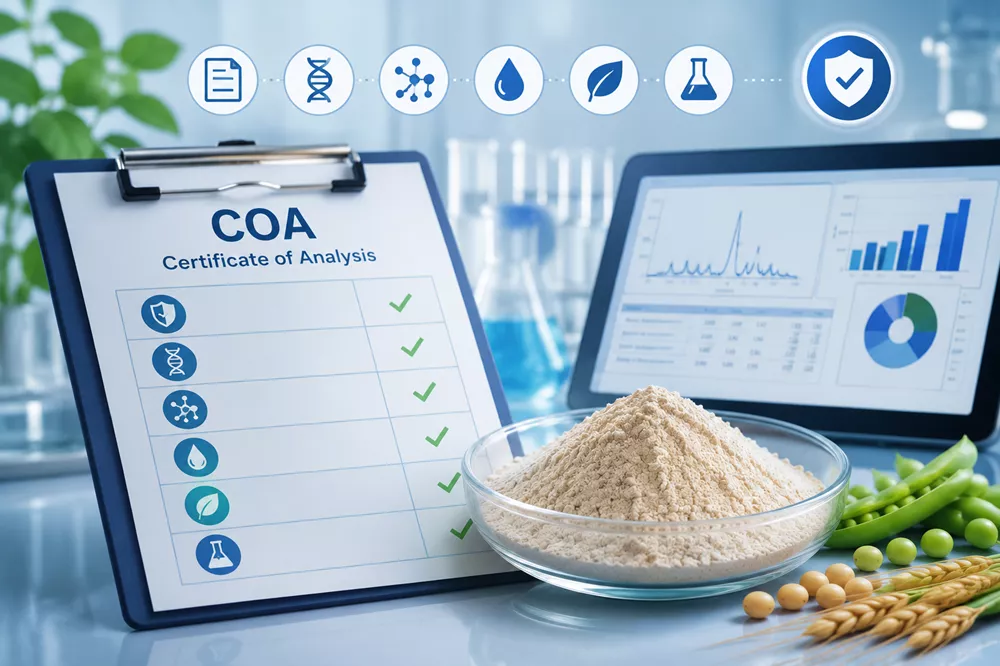
Hydrolyzed plant proteins undergo controlled enzymatic processing, which yields stable peptide chains. Manufacturers list a retest date on the analytical document rather than an arbitrary expiration date. The retest date indicates the exact point when technicians must re-evaluate the material for moisture absorption or physical changes.
Storage conditions directly influence functional stability over time. Formulators monitor retest dates to maintain proper inventory rotation in production warehouses. Active testing protocols ensure that older lots meet initial quality specifications before entering the blending phase.
Testing laboratories must demonstrate technical competence through formal accreditation standards. An ISO/IEC 17025 accreditation confirms that an independent laboratory operates under validated analytical methods and calibrated equipment. Regulators require this standard to ensure data integrity across international supply lines.
A verified plant protein peptide COA displays the testing facility's accreditation seal alongside unique certificate numbers. Procurement teams reject analytical reports from non-accredited internal testing facilities. This rigorous verification protects functional food brands from compliance violations and formulation errors.
Molecular identity parameters confirm the structural integrity of active peptides. Testing laboratories analyze physical, chemical, and biochemical traits to verify functional performance before raw material release. These analytical checks protect production batches against batch-to-batch variation.
Enzymatic hydrolysis breaks native protein structures into targeted short-chain fractions. Specific proteases cleave disulfide bonds and degrade native insoluble proteins into soluble peptides. Beyond Biopharma engineers high-performance peptides through controlled enzymatic processing. This process yields low-molecular-weight peptides between 1,000 and 3,000 Da for rapid digestion and superior bioavailability.
The degree of hydrolysis directly shapes physical functionality. The following table illustrates how molecular weight profiles alter functional performance:
Functional Property | Impact of Molecular Weight Profile | Key Mechanism / Observation |
|---|---|---|
Water Holding Capacity | Enhances with smaller peptide fragments | Lower-molecular-weight peptides exhibit greater hydrophilicity to bind water. |
Solubility | Increases with lower molecular weight | Degradation into smaller structures exposes polar groups for hydrogen bonding. |
Foaming Stability | Decreases with excessive molecular breakdown | Higher molecular weight peptides maintain necessary film strength. |
Emulsification | Improves with lower molecular weight fractions | Reduced molecular size boosts overall emulsification performance. |
Surface Hydrophobicity | Generally reduces in smaller peptides | Shorter peptide chains feature fewer exposed hydrophobic residues. |
Peptide size distributions vary across raw material sources:
Soybean Protein hydrolysates yield 55.3% of fractions under 1000 Da.
Pea Protein hydrolysates yield 62.6% of fractions under 1000 Da.
Reference studies show soy protein hydrolysates contain 74.83% of fractions between 200–1000 Da and 19.57% between 1000–5000 Da.
High-resolution mass spectrometry validates the exact mass match of target bioactive sequences. Analysts follow a precise three-step testing procedure:
Electrospray Ionization creates a charge state envelope containing species like [M+2H]^{2+} and [M+3H]^{3+}.
Deconvolution Analysis converts multi-charge spectral data into a single zero-charge monoisotopic mass.
Theoretical Comparison evaluates observed mass against calculated molecular mass.
A plant protein peptide COA documents these mass spectrometry findings. Modern LC-MS/MS equipment requires mass accuracy within 5 parts per million (ppm). This high precision yields a tight tolerance within 0.02 Da for a 2,000 Da peptide sequence. Small peptides must show an observed mass within less than 1 Da of theoretical values. Mass discrepancies exceeding 0.5% indicate structural errors or improper identity. Outdated ±0.1% historical standards allow a broad variance of ±3 Da on a 3,000 Da sequence, which masks critical deviations.
Physical testing confirms sensory appeal and functional performance across various commercial applications. Beyond Biopharma utilizes multi-stage purification and debittering technologies to process pea, soybean, rice, wheat, corn, and walnut sources. This multi-stage debittering removes unpleasant off-notes and creates a neutral sensory profile.
Cold-water solubility standards ensure immediate powder dissolution. Beyond Biopharma delivers 100% cold-water solubility without clumping, grit, or sedimentation. The raw material remains crystal-clear in solution across a broad pH range. Formulators can easily integrate these stable peptides into transparent functional beverages, ready-to-drink sports supplements, clinical nutrition, and instant powder drinks. Manufacturers achieve stable formulations in high-protein plant-based foods, dairy alternatives, and bakery items.
Purity and quantitative specs confirm the exact concentration of active components inside raw peptide powders. Formulators must evaluate these key metrics to prevent costly manufacturing errors and maintain strict batch-to-batch consistency.
High-Performance Liquid Chromatography (HPLC) separates target plant protein peptides from residual impurities. Lab technicians pump liquid solvent containing the dissolved raw material through a packed analytical column under high pressure. Different chemical compounds pass through the stationary phase column at varying speeds based on individual molecular interactions. Reverse-phase HPLC specifically utilizes hydrophobic interactions to isolate short-chain peptides from intact protein fragments, free amino acids, and reaction byproducts.
The optical detector records target peptide absorption peaks against baseline signal levels. Chromatographic analysis calculates purity by measuring the relative area under the curve for target peak signals. High percentage purity values confirm minimal presence of residual enzymes or unhydrolyzed native proteins. Quality control teams review these detailed chromatograms to verify batch consistency before releasing raw ingredients for commercial manufacturing operations. This high-resolution separation technique identifies subtle molecular variations across individual production lots.
Procurement teams must distinguish total raw powder mass from true active content on every plant protein peptide COA. Gross powder mass includes active target peptides, bound moisture, residual ash, and salt counterions. Calculating active dosage based solely on total powder weight leads to severe under-dosing errors in final product formulations.
Formulators determine true net peptide content by evaluating total nitrogen concentration alongside purity numbers. Technical specialists use a standard conversion formula to calculate actual active mass: net peptide content = total powder weight x protein purity percentage x (100 - moisture percentage) / 10000. Evaluating net peptide content guarantees accurate active ingredient dosing across functional food, beverage, and nutraceutical product lines. Inaccurate raw material accounting alters the finished product amino acid profile and reduces expected health benefits for end consumers.
Moisture management prevents microbial spoilage and powder caking during long-term storage. Laboratory analysts prefer Karl Fischer (KF) titration over traditional Loss-on-Drying (LOD) techniques for hygroscopic plant protein hydrolysates.
Scientifically, Karl Fischer titration provides superior accuracy by exclusively targeting water molecules, unlike gravimetric or loss-on-drying techniques which are susceptible to interference from other volatile components.
The table below outlines the analytical performance differences between these two moisture testing methods:
Parameter / Feature | Karl Fischer (KF) Titration | Loss-on-Drying (LOD) Method |
|---|---|---|
Analytical Target | Targets water molecules exclusively via stoichiometric reaction with iodine. | Measures all mass loss from any volatile substance during heating/vacuum. |
Specificity | High; unaffected by non-water volatile substances or solvents. | Low; captures non-water volatiles like residual synthesis solvents and acids. |
Impact of Counterions | Ignores liberated acids (e.g., acetic acid or trifluoroacetic acid). | Overstates water content by including volatile acids from counterion breakdown. |
Sensitivity Level | Resolves microgram-level (trace) moisture, ideal for small peptide samples. | Less sensitive; unsuitable for accurately measuring trace moisture in small fills. |
An accurate plant protein peptide COA lists validated Karl Fischer moisture values to verify raw material stability. Controlling residual water content prevents active powder degradation and maintains free-flowing physical traits during high-speed automated packaging operations.
Bacterial endotoxins originate from the outer cell membrane of Gram-negative bacteria. Raw plant materials pick up bacterial contaminants during agricultural harvesting and liquid extraction phases. Laboratory technicians conduct the chromogenic Limulus Amebocyte Lysate assay to quantify pyrogenic lipopolysaccharide levels. This safety assay ensures raw materials satisfy strict purity thresholds for clinical applications, infant formulas, and dietary supplements.
A compliant assay protects sensitive consumers from adverse inflammatory responses, fever, or vascular collapse. Quality control teams review test results to verify facility sanitation and ultra-pure water usage during enzymatic processing. Strict control of endotoxin levels prevents batch degradation and protects active peptide performance in liquid functional beverages.
Plant crops naturally absorb trace elements and heavy metals from agricultural soil and irrigation water. Analytical laboratories utilize Inductively Coupled Plasma Mass Spectrometry to detect trace elemental contaminants at parts-per-billion sensitivity. This high-precision method converts sample elements into ions inside high-temperature argon plasma before measuring atomic mass ratios.
High-precision instruments screen hydrolysate powders for toxic heavy metals. The table below lists the four primary heavy metal contaminants monitored during raw material testing:
Heavy Metal | Primary Health Risk / Concern |
|---|---|
Lead | Accumulates in human tissue and damages neurological systems. |
Cadmium | Induces chronic kidney toxicity and weakens skeletal structure. |
Arsenic | Acts as a known carcinogen causing systemic organ damage. |
Mercury | Impairs central nervous system and cardiovascular functionality. |
Processing facilities use organic solvents during plant lipid extraction and fraction purification steps. Laboratory specialists perform Gas Chromatography testing with flame ionization detection to identify volatile organic compounds in raw peptide powders. Gas chromatography vaporizes the test sample to separate residual chemical compounds along a temperature-controlled capillary column. This analytical method isolates residual processing solvents, including ethanol, methanol, and hexane.
Low residual solvent levels guarantee compliance with global food safety regulations and raw material purity standards. Formulators inspect the plant protein peptide COA to ensure residual chemicals fall well below strict legal limits. Verifying complete solvent clearance guarantees a clean ingredient with zero chemical off-flavors, synthetic pollutants, or toxic residues.
Procurement specialists must inspect technical documentation for critical omissions before approving raw ingredient shipments. Non-accredited internal testing facilities often generate untrustworthy analytical results. Missing Karl Fischer moisture values obscure raw material degradation risks during long-term storage. Unreported moisture levels cause inaccurate powder weight calculations and batch instability in warehouse storage.
A missing analytical method creates another major warning sign on a plant protein peptide COA. Certificates without explicit testing protocols prevent quality control teams from verifying chromatographic accuracy. Obsolete testing standards fail to detect subtle impurities or molecular weight shifts. Quality assurance managers must reject documents lacking clear methodology details or accredited third-party laboratory seals.
Formulators must convert total raw powder mass into true active peptide content. Raw protein hydrolysates naturally contain bound moisture, residual ash, and counterions. Technicians utilize a simple conversion equation: net active peptide mass = total powder weight x (purity percentage / 100) x ((100 - moisture percentage) / 100). This mathematical formula reveals the actual active payload per kilogram of raw powder material.
Precise calculations prevent costly under-dosing errors in finished nutraceutical formulations. Food scientists rely on this conversion formula to maintain consistent batch potency across commercial manufacturing runs. Accurate dosing protects product efficacy and ensures predictable bioavailability for end consumers. Precise accounting also preserves correct amino acid balances in functional food and beverage applications.
Beyond Biopharma establishes an industry benchmark for raw material transparency, purity, and functional quality. The company manufactures non-GMO and vegan-friendly ingredients sourced from pea, soybean, rice, wheat, corn, and walnut. These diverse protein sources help formulators design clean-label, hypoallergenic products. Advanced debittering technologies eliminate bitter off-notes while maintaining 100% cold-water solubility across broad pH ranges.
Manufacturers access extensive custom processing options to meet unique product formulation needs. Beyond Biopharma delivers tailored degrees of hydrolysis, custom particle sizing, and bespoke ingredient blending options. Their technical team provides full regulatory documentation alongside fully validated analytical certificates. These comprehensive quality guarantees ensure seamless regulatory compliance and superior physical performance in high-speed production operations.
Systematically evaluating every specification on a plant protein peptide COA protects manufacturing integrity. Quality assurance teams must verify raw materials prior to production release. True net peptide content, mass spectrometry identity checks, and strict contaminant profiles remain non-negotiable quality metrics for premium functional foods and nutraceuticals. These rigorous checks guarantee accurate product dosing, high biological activity, and complete consumer safety. Formulators eliminate batch variability through thorough document reviews. Manufacturers can elevate their functional product lines by choosing Beyond Biopharma. Beyond Biopharma provides fully transparent, validated, and customizable plant protein peptide solutions tailored for optimal performance. Partner with Beyond Biopharma today to secure superior raw material standards.
Total raw powder mass includes target peptides, bound moisture, residual ash, and salt counterions. Measuring active ingredients using only total powder weight causes severe under-dosing. Calculating true net peptide content ensures accurate active ingredient dosing across functional food, beverage, and nutraceutical product lines.
Beyond Biopharma engineers plant protein peptides between 1,000 and 3,000 Da using controlled enzymatic processing. This short-chain molecular weight range delivers rapid digestion, superior bioavailability, and high cold-water solubility without the clumping or sedimentation typical of intact protein isolates.
Karl Fischer titration targets water molecules exclusively through a stoichiometric reaction. The Loss-on-Drying method measures all mass loss from any volatile substance. Karl Fischer analysis provides higher specificity for hygroscopic plant protein hydrolysates because residual volatile acids do not alter the final moisture measurement.
Beyond Biopharma produces peptides from six plant sources: pea, soybean, rice, wheat, corn, and walnut. All options feature 100% plant-based, non-GMO, and vegan-friendly standards. Formulators easily blend these distinct peptide sources to construct balanced amino acid profiles or create clean-label, hypoallergenic products.



Tel:+86 21 65010906
Cell/Whatsapp/Wechat:
+86 13482884055
+86 18657345785
Email: sales@beyondbiopharma.com





 English EN


