As the plant-based nutrition market expands, formulators face persistent challenges with protein bioavailability, solubility, and texture. Wheat protein peptide, derived through advanced enzymatic hydrolysis, offers a solution that bridges the gap between consumer demand for plant-based ingredients and the technical requirements of modern food and supplement manufacturing. This article explores the science, applications, and selection criteria for this functional ingredient.
Wheat protein peptide offers significantly higher digestibility and absorption rates compared to intact wheat protein, making it suitable for high-bioavailability formulations.
The enzymatic hydrolysis process reduces molecular weight, improving solubility in acidic and neutral pH environments, which expands application possibilities.
This ingredient supports clean-label and vegan product development, aligning with current consumer preferences for sustainable and plant-derived nutrition.
Evaluating supplier capabilities in enzyme technology, molecular weight control, and quality certification is critical for consistent product performance.
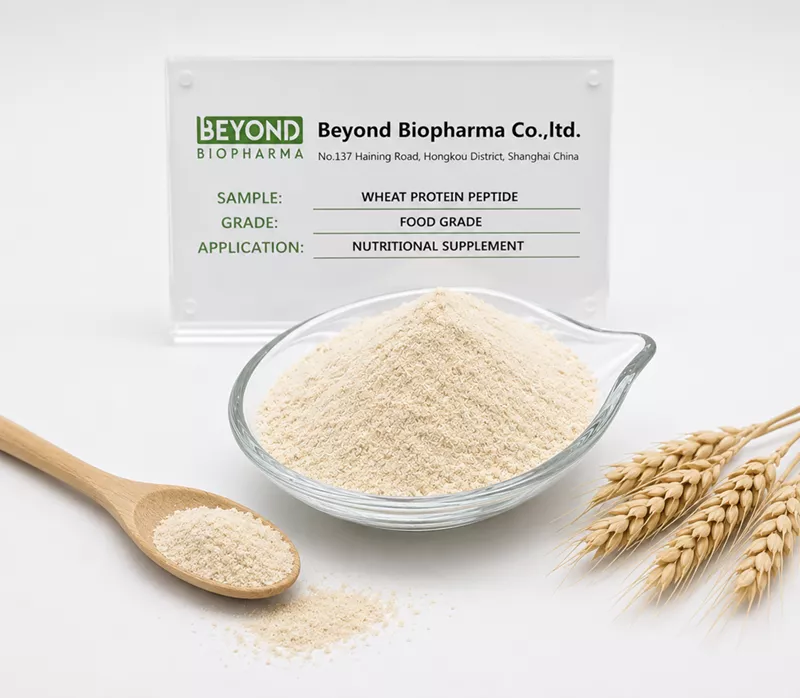
Wheat protein peptide is a functional ingredient produced by breaking down wheat protein—typically gluten or wheat gluten isolate—into smaller peptide chains and amino acids through controlled enzymatic hydrolysis. Unlike intact wheat protein, which consists of large, complex molecules, these peptides have a reduced molecular weight, typically ranging from 500 to 3000 Daltons, depending on the degree of hydrolysis.
The production process begins with extracting protein from wheat grains, followed by purification to remove non-protein components. The protein is then subjected to food-grade proteases under specific temperature and pH conditions to cleave peptide bonds. After hydrolysis, the mixture undergoes separation and drying to yield a fine powder with consistent functional properties.
Key characteristics of wheat protein peptide include high solubility across a wide pH range (2.0 to 8.0), rapid dispersibility in water, and improved digestibility. These properties distinguish it from conventional wheat protein, which often exhibits poor solubility and forms viscous pastes in solution. The peptide form also reduces the risk of allergenicity associated with intact gluten proteins, though it is not suitable for individuals with celiac disease.
In terms of amino acid profile, wheat protein peptide is rich in glutamine, proline, and branched-chain amino acids (BCAAs), which are valuable for muscle recovery and metabolic support. This composition makes it a relevant ingredient for sports nutrition and functional food applications.
The conversion of wheat protein into peptides through enzymatic hydrolysis yields several measurable improvements in functional performance. These advantages are grounded in protein chemistry and directly impact formulation outcomes.
Higher Digestibility and Bioavailability. Intact wheat protein has a protein digestibility-corrected amino acid score (PDCAAS) of approximately 0.25 to 0.45, limited by its low lysine content and structural resistance to gastrointestinal enzymes. In contrast, wheat protein peptide is predigested, meaning the peptide bonds are already partially cleaved. This reduces the workload on digestive enzymes and allows for faster amino acid absorption. Research suggests that peptides with molecular weights below 1000 Daltons can be absorbed directly via peptide transporters in the intestine, bypassing the need for complete breakdown.
Improved Solubility and Dispersion. Traditional wheat protein tends to form aggregates when mixed with water, leading to sedimentation and poor mouthfeel. Wheat protein peptide, due to its smaller size and increased surface charge, dissolves readily in both cold and warm water. It remains stable in acidic environments, such as fruit-based beverages or sports drinks with a pH of 3.0 to 4.0, without precipitation. This property is critical for ready-to-drink (RTD) protein shakes and clear protein beverages.
Enhanced Formulation Flexibility. Because wheat protein peptide does not form a gluten network when hydrated, it can be incorporated into formulations where gluten development would be undesirable, such as in gluten-free products or liquid nutritional supplements. It also exhibits lower viscosity at high concentrations compared to intact protein, allowing for higher protein loading without compromising flowability or texture.
Potential Bioactive Properties. Industry experience indicates that certain peptide sequences derived from wheat protein may exhibit antioxidant or angiotensin-converting enzyme (ACE) inhibitory activity. While these effects are not clinically established for all products, they suggest additional value for functional ingredient positioning. Under typical formulation conditions, these bioactivities are preserved if the hydrolysis process is carefully controlled.
Wheat protein peptide is used across multiple segments of the nutrition industry. Its functional profile addresses specific formulation challenges that conventional plant proteins cannot easily solve.
In sports nutrition, rapid amino acid delivery is a key requirement. Wheat protein peptide provides a plant-based alternative to whey hydrolysates, with a similar absorption profile. It is commonly used in post-workout recovery powders, ready-to-drink shakes, and amino acid blends. Its high solubility allows for clear or low-viscosity formulations, which are increasingly popular among athletes seeking lighter options.
Clear protein beverages are a growing category, particularly in markets like North America and Europe. Traditional plant proteins, such as pea or soy, produce cloudy or gritty drinks. Wheat protein peptide, when processed to a fine particle size, can be used to create transparent or lightly turbid beverages. It also contributes a neutral flavor profile, reducing the need for masking agents.
For functional food applications, such as protein bars, meal replacements, and fortified snacks, wheat protein peptide offers a high protein content with low viscosity. It can be incorporated into baked goods, extruded snacks, and confectionery without significantly altering texture. In dietary supplements, it is used as a base for peptide blends targeting muscle maintenance, satiety, or general wellness.
Older adults often face reduced digestive efficiency and muscle loss. Wheat protein peptide, with its predigested nature, provides an easily absorbable protein source. It is used in geriatric nutritional supplements, oral nutritional supplements (ONS), and protein fortification for soups and purees.
In the plant-based meat and dairy alternative sector, wheat protein peptide can serve as a binder or texturizer. It also helps boost protein content without the heavy mouthfeel associated with concentrated plant proteins.
| Property | Traditional Wheat Protein | Wheat Protein Peptide |
|---|---|---|
| Digestibility | Limited due to large molecular size and gluten structure | High; predigested for rapid absorption |
| Solubility | Poor; forms aggregates and viscous pastes | Excellent; soluble across pH 2.0–8.0 |
| Formulation Flexibility | Low; gluten network formation limits applications | High; compatible with liquid, dry, and acidic systems |
| Mouthfeel | Gritty or pasty | Smooth; low viscosity at high concentrations |
| Application Range | Limited to baked goods and textured products | Beverages, supplements, sports nutrition, functional foods |
✅ Product Positioning Advice: Position wheat protein peptide as a high-bioavailability, clean-label ingredient for premium plant-based nutrition lines. Emphasize its solubility and neutral flavor in marketing materials.
✅ Recommended Application Directions: Focus on clear protein drinks, post-workout recovery blends, geriatric supplements, and high-protein functional beverages. These categories benefit most from the peptide's functional advantages.
✅ Formulation Development Considerations: Start with a usage level of 5–15% depending on the target protein content. Conduct stability testing in acidic and thermal conditions. Use with other plant proteins to balance amino acid profiles if needed.
✅ Raw Material Selection Notes: Choose suppliers who provide molecular weight distribution data and solubility profiles. Verify that the product is free from residual solvents and has a low microbial load.
Selecting a reliable supplier for wheat protein peptide requires a technical assessment of their production capabilities and quality systems. The following criteria are essential for ensuring consistent ingredient performance.
Raw Material Source Quality. The starting wheat protein should be sourced from non-GMO, pesticide-controlled crops. Suppliers should provide documentation on the origin, protein content, and purity of the raw material. Traceability is critical for both regulatory compliance and product consistency.
Enzyme Hydrolysis Technology. The enzyme selection and process parameters—temperature, pH, reaction time—determine the final peptide profile. A competent supplier will have in-house expertise in protease selection and process optimization. They should be able to provide data on degree of hydrolysis (DH) and molecular weight distribution.
Molecular Weight Control. For consistent functionality, the peptide molecular weight should fall within a defined range. Suppliers who use ultrafiltration or chromatography to fractionate peptides can offer more uniform products. Request a molecular weight distribution graph to assess consistency.
Product Stability and Shelf Life. Accelerated stability studies should demonstrate that the peptide retains solubility and amino acid integrity over 12–24 months. Moisture content, bulk density, and flowability are also important for handling and storage.
Quality Management Systems. Look for certifications such as ISO 9001, HACCP, FSSC 22000, and GMP. These indicate that the supplier follows standardized procedures for production, testing, and traceability. Halal and Kosher certifications may be required depending on target markets.
✅ Raw material traceability and non-GMO documentation
✅ Technical data sheet with degree of hydrolysis and molecular weight range
✅ Certificate of analysis (COA) for each batch, including solubility and microbial limits
✅ Application development support and formulation guidance
✅ Supply chain reliability with consistent lead times and inventory management
Regular plant protein consists of intact protein molecules that require full digestion before absorption. Wheat protein peptide is enzymatically broken down into smaller peptides, which are absorbed more quickly and require less digestive effort. This results in higher bioavailability and better solubility in formulations.
Yes. A higher degree of hydrolysis produces shorter peptides with lower molecular weight, which improves solubility and absorption but may increase bitterness. A lower degree of hydrolysis retains some functional properties of intact protein. The optimal DH depends on the target application and desired taste profile.
It is particularly suitable for clear protein beverages, sports nutrition powders, liquid meal replacements, and geriatric nutritional supplements. It also works well in high-protein snack bars and functional foods where solubility and low viscosity are required.
Key quality indicators include molecular weight distribution, degree of hydrolysis, solubility at different pH levels, and microbial purity. Request a certificate of analysis and a technical data sheet from the supplier. Stability data and third-party testing for heavy metals and allergens are also recommended.
Wheat protein peptide offers a technically sound solution for formulators seeking a plant-based protein ingredient with improved digestibility, solubility, and application flexibility. Its enzymatic hydrolysis process allows for controlled molecular weight and functional properties that address common limitations of traditional plant proteins. The ingredient is well-suited for sports nutrition, functional beverages, dietary supplements, and aging nutrition products.
For product developers and ingredient buyers, the next step is to evaluate suppliers based on their technical capabilities, quality certifications, and application support. Requesting a sample and reviewing the molecular weight distribution data will provide practical insight into product consistency.
To explore how wheat protein peptide can fit into your product development pipeline, contact our application engineering team for technical documentation and formulation guidance.



Tel:+86 21 65010906
Cell/Whatsapp/Wechat:
+86 13482884055
+86 18657345785
Email: sales@beyondbiopharma.com


 English EN




