EN
Edible gelatin is one of those ingredients that rarely gets the spotlight but quietly holds together a surprising share of the food and beverage products people reach for every day. Its value comes from a combination of gelling strength, thermoreversible melting, water binding, foaming, and clarifying ability — functions that are difficult to replace with a single plant-based alternative at the same cost and processing reliability. The figures below are drawn from published manufacturer data and the Gelatin Manufacturers Institute of America reference table, so they reflect what actually happens on production lines rather than idealized lab conditions.
What follows: ten application areas, the typical use level and Bloom range for each, and the specific functional job gelatin performs. A consolidated parameter table sits near the end for quick reference. Product examples link to bovine, porcine, and fish gelatin grades where those sources match the application.
The order below moves roughly from confectionery — gelatin’s largest traditional home — through dairy, meat, and beverage uses. Each entry pairs the application with the use level and Bloom range reported in GMIA reference data.
This is gelatin’s signature application. A 200–250 Bloom porcine or bovine gelatin at roughly 7–9% of the candy mass delivers the elastic chew and bright clarity that define a quality gummy. Porcine gelatin is often chosen here because its gel melts close to body temperature, so the candy stays firm on the shelf but releases flavor quickly in the mouth. Lower Bloom at higher concentration produces a softer, stretchier bite; higher Bloom at lower concentration gives a shorter, firmer texture.
Marshmallow depends on gelatin for more than setting — it stabilizes the air foam that gives the product its characteristic spring. A high-Bloom gelatin (225–275) at around 2% restrains sugar crystallization and keeps the foam structure intact through whipping, depositing, and storage. Without gelatin, the aerated structure collapses and the texture turns grainy.
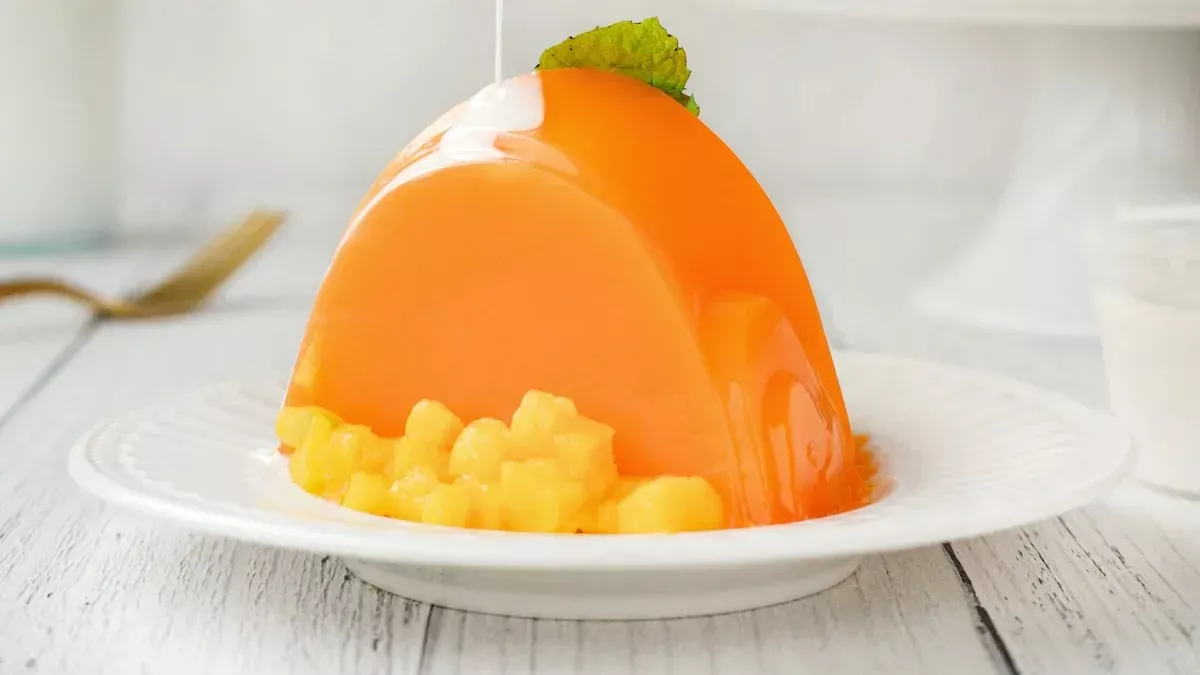
Ready-to-eat gelatin desserts use a similar concentration to gummies but a broader Bloom window, because the target texture is a soft, spoonable gel rather than a chewy bite. Bovine gelatin’s slightly higher melting point compared with porcine can be an advantage in warm-climate distribution, where a gel that holds shape at ambient temperature matters more than immediate melt-in-mouth release.
In stirred and set yogurt, gelatin reinforces the protein network and reduces syneresis — the watery separation that appears on the surface after storage. Use levels sit in the 0.2–1.0% range, with 150–250 Bloom bovine gelatin being a common choice. At around 0.4%, studies show a measurable increase in gel strength and a drop in serum separation, without masking the cultured dairy flavor.
Gelatin’s job in ice cream is to control ice crystal growth and improve melt resistance. A 250-Bloom gelatin at 0.25–0.5% is the conventional window, though usage has declined as formulators shifted toward other hydrocolloid blends. Where it is used, the benefit is a smoother, creamier texture and a slower, more controlled melt on the palate.
These products need a gel that sets softly but holds a defined shape through layering and slicing. Gelatin delivers a clean, elastic set that cuts cleanly and melts without a starchy mouthcoat. Bovine gelatin is often selected when the dessert must survive a few hours at room temperature during service; fish gelatin suits delicate, fast-melting chilled desserts where a lower melt point is desirable.
In ham, sausages, canned meats, and restructured products, gelatin binds water and improves sliceability. At 1–5% use level, it enhances juiciness during cooking and helps the product hold together after slicing. The bloom range is broad because the job varies: a higher Bloom contributes more structural cohesion, while a moderate Bloom focuses on moisture retention without a rubbery bite.
Gelatin forms a clear, glossy film that protects moisture loss and improves visual appeal on pâtés, terrines, and coated meat products. The same film-forming property is used in bakery glazes and in the pharmaceutical soft-gel shell, where clarity and mechanical strength are critical. This is a lower-volume but technically demanding use — the gelatin must set at the right speed to level evenly before gelling.
At tiny doses — 0.002–0.015% — gelatin acts as a fining agent. It binds suspended tannins and haze-forming particles, which then settle out and are removed. The result is a brighter, more stable beverage without filtration that strips aroma compounds. This is one of the oldest and most dose-sensitive applications; over-addition can strip color and body, so precision matters more than in gelling uses.
Vitamin, mineral, and botanical gummies have become a major growth segment for edible gelatin. These systems demand more than a pleasant texture: the gelatin network must remain stable through shelf life, protect sensitive actives from moisture migration, and deliver a consistent dose. High-Bloom gelatin with precise viscosity control is the typical specification, and the grade selection is often supported by documentation for heavy metals and solvent residues.
The values below are consolidated from the Gelatin Manufacturers Institute of America reference data and published product specifications. Treat them as starting points for formulation trials, not fixed rules — the right grade depends on your process temperature, set time, and target texture.
| Application | Typical use level | Bloom range | Primary function |
|---|---|---|---|
| Gummy candies | 7–9% | 200–250 | Elastic chew, clarity, flavor release |
| Marshmallows | 1.7–2.5% | 225–275 | Foam stabilization, sugar crystallization control |
| Gelatin desserts | 7–9% | 175–275 | Soft, spoonable gel structure |
| Yogurt / dairy | 0.2–1.0% | 150–250 | Syneresis reduction, body |
| Ice cream | 0.25–0.5% | ~250 | Ice crystal control, melt resistance |
| Meat products | 1–5% | 175–275 | Water binding, cohesion, sliceability |
| Beer / wine / juice | 0.002–0.015% | 100–200 | Clarification, tannin binding |
Source basis: GMIA reference table for gelatin use levels and Bloom ranges; product specification ranges for bovine (120–270 Bloom), porcine (150–250 Bloom), and fish (0–50 Bloom) grades as published by suppliers.
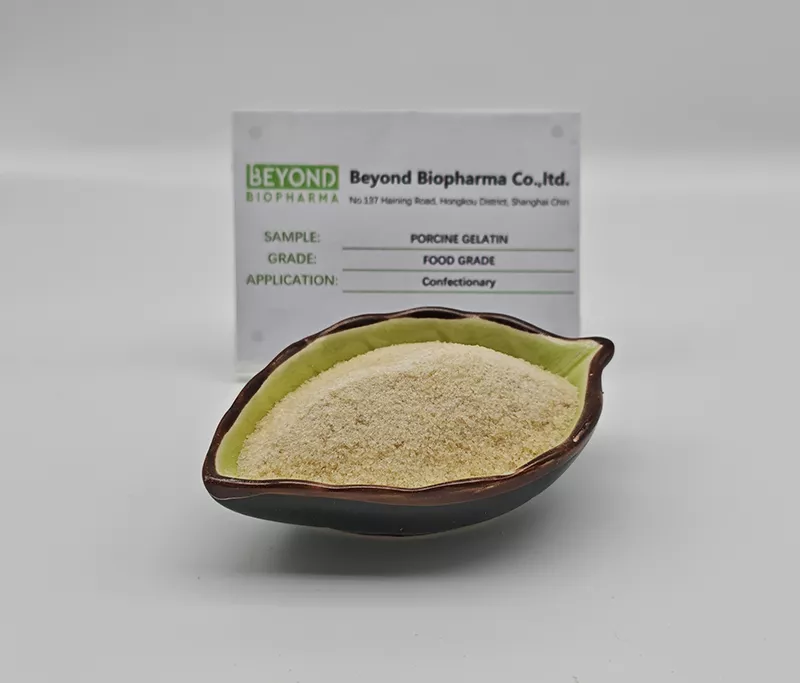
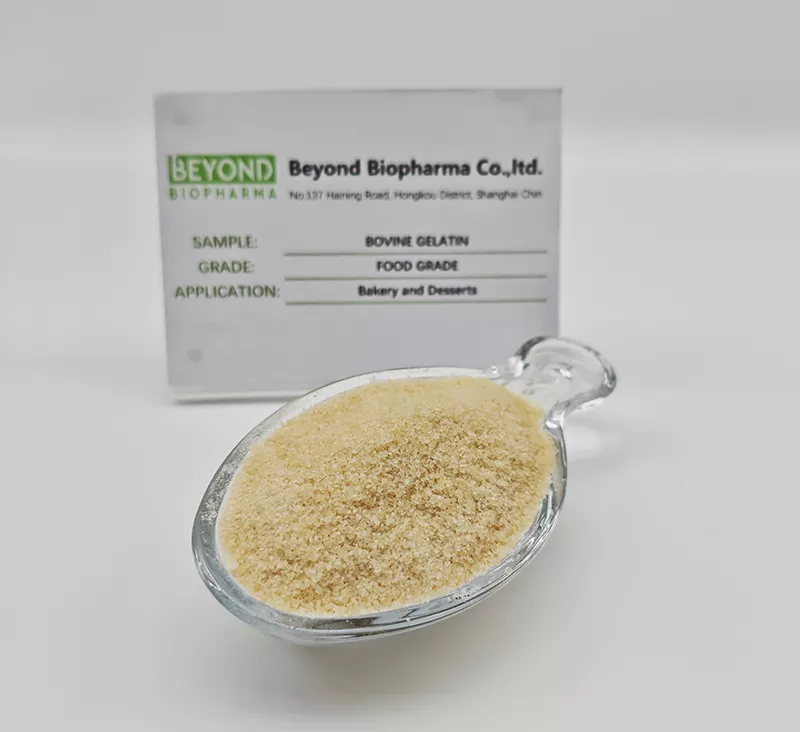
The source matters less for basic gelling than for melting behavior, dietary certification, and cost structure. Bovine gelatin typically offers the highest gel strength and a slightly higher melting point, which helps in warm-climate distribution and applications needing structural integrity. Porcine gelatin melts near body temperature and is the benchmark for melt-in-mouth confectionery, often at a lower cost and with robust global supply. Fish gelatin has a lower Bloom and a lower melting point (around 25°C), making it the practical choice when halal and kosher certification are non-negotiable, or when a rapidly melting, delicate gel is the target.
A useful rule of thumb: if the product must hold shape at ambient temperature, lean bovine; if the eating experience depends on a clean, quick melt, lean porcine; if certification or a lower melt point drives the brief, lean fish.
Published market estimates for edible gelatin vary by scope and methodology, but the direction is consistent: moderate single-digit annual growth driven by confectionery, dairy desserts, and the expansion of nutraceutical gummies. The application-level data in this page is more actionable than headline market figures for formulation work — the Bloom number, use level, and source selection will determine whether a product succeeds on the line and on the shelf, regardless of the broader market trajectory.


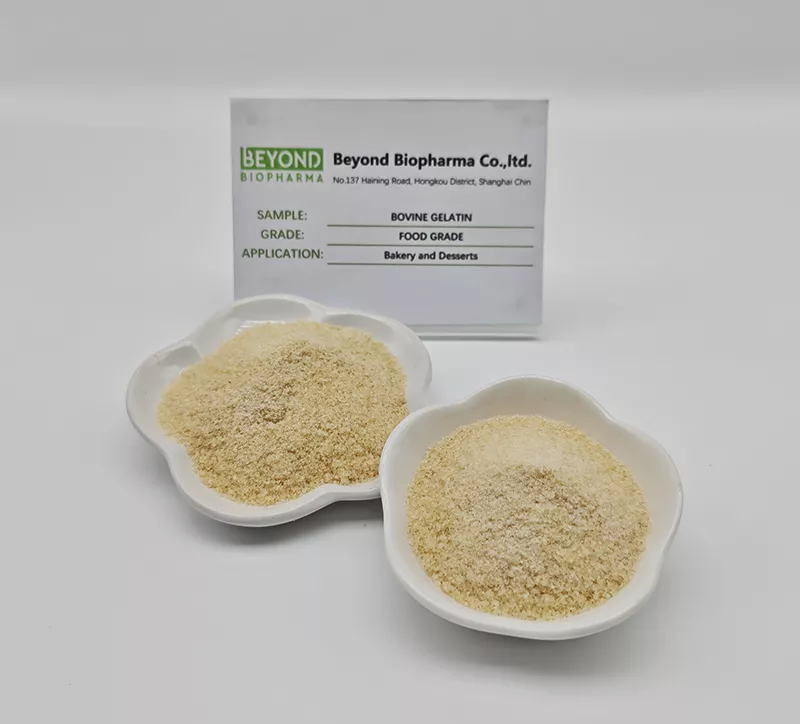
A practical overview of ten edible gelatin applications ranging from confectionery and dairy stabilization to pharmaceutical capsules and wine fining. The article covers technical considerations like Bloom values and usage concentrations, helping food manufacturers and formulators make informed ingredient decisions in 2026.
Tel:+86 21 65010906
Cell/Whatsapp/Wechat:
+86 13482884055
+86 18657345785
Email: sales@beyondbiopharma.com





 English EN